When I first moved to Berlin, someone told me that there is a radioactive metro station somewhere in the city. Since then, I was on a mission to find it but unfortunately, with little to no success… until recently.
One of the most iconic places in Berlin must be the Brandenburger Tor and only one station away from it is the Potsdamer Platz which is home to the Sony Center as well as The Mall of Berlin, but today, we are going to focus what lies underneath the ground.
A few days ago I was coming back home from work and I had to change trains at the Potsdamer Platz S-Bahn station and as I was waiting for my train, a characteristic orange colour of the tiles caught my eye. From my bag I quickly took out my trusty Terra-P Geiger counter and I brought it near the tiles and within seconds the alarm started screaming.
Interestingly, after measuring a bunch of the orange tiles, I noticed that not all of the them where radioactive. This is most probably because some of those tiles have been replaced with newer ones which do not contain radioactive elements.
A quick gamma spectroscopy of the tiles made with my RAYSID gamma spectrometer, confirmed the presence of uranium. The peak at 186 keV indicates that these tiles contain Uranium-235 which means they were produced using natural uranium and not depleted.
Although these tiles make my Geiger counter scream, they are in fact harmless. That is because they emit mainly alpha and beta radiation and standing just a half meter away from them will result in radiation dropping to normal background levels.
So next time you are going to be visiting Berlin, make sure to bring a Geiger counter with you and check out the Potsdamer Platz S-Bahn station!
Today I want to show you an item that you can find in a hardware store and it is radioactive. Let’s take a closer look at the thoriated Tungsten electrodes!
Main information
There are three types of thoriated Tungsten electrodes with the only difference being the amount of Thorium in them. Yellow ones contain around 1% of Thorium, red contain 2% and orange contain 4%. Even though orange ones contain the highest amount of Thorium, they are actually not much more radioactive than the red ones which are the most common. Tungsten electrodes come in different sizes with the bigger ones being slightly more active. Personally, I decided to go with 3.2mm x 175mm but smaller should also work fine.
Red Tungsten Electrodes (WT20)
Isotope: 232Th
Activity: < CPM (LND 7311)
Amount: ~2%
Since the label on the box clearly states that these electrodes contain Thorium, I didn’t expected the gamma spectroscopy to show anything intresting but to my suprise, it did!
Slide to the right to see Thorium gas mantle spectrum Slide to the Left to see Thoriated Tungsten electrodes spectrum
The main two differences between the spectrum of Tungsten electrodes and the spectrum of Thorium gas mantle are the peak at 511 keV and the peak 583 keV. Let’s start with the peak at 511 keV. It is referred to as annihilation peak and it is caused by the annihilation of a positron by its interaction with an electron. This event can occur more often in Tungsten electrodes because of their density. The peak at 583 keV is caused by Thallium 208. When Thorium decays, it emits Radon 220 which is a gas and it escapes into the air but in the case of the Tungsten electrodes, it is trapped by dense Tungsten which results in the accumulation of Radon decay products including Thallium 208.
These electrodes are often used as a check source because of how easy to find they are and their small activity which makes them relatively safe. That being said, when used for their original purpose, the dust generated by sharpening them could cause health problems in the long run if inhaled.
Fake Tungsten Electrodes
When buying these electrodes, make sure to buy branded ones because unfortunately, unbranded ones are often fake and they do not contain Thorium. I made this mistake twice and both times I received fake electrodes that weren’t radioactive.
Today we will take a closer look at a radioactive, soviet switch, the BH-45M!
The production of BH-45M switches started in 1945 and continues till this day, this being said, not all of those switches are radioactive. Units produced until 1965 used radium paint but in later models, radium paint was replaced by a nonradioactive one. The very early models which were produced until early 1950s, used RaBr2 while the ones produced later used RaSO4. BH-45M switches are mainly used in military vehicles such as tanks but can also be found in some civilian ones. These switches were produced in countries of Warsaw Pact and can be found today cheaply at antique markets.
As a result of constant exposure to nuclear radiation, the paint decays and with time it loses its radioluminaces properties. Today the glow from the switch is undetectable for human eye but a photo made with a long exposure shows that there is still little bit of glow left.
Long exposure of BH-45M switch
Radium is a particularly nasty element not only because of its very high activity and radio toxicity but also because it decays into a radioactive gas called radon which in large doses can be dangerous. Luckily, the switch I have is pretty well sealed and doesn’t leak too badly, so the radon emission is relatively low.
Activity and Gamma Spectroscopy
Radium painted items range in activity anywhere from few hundred CPM to hundreds of thousands depending on the amount of radium paint used. When it comes to BH-45M switches, they are definitely are on the hotter side. The one I have measures at around 220k CPM at 1cm distance on a pancake probe and 10uSv/h gamma only at 1cm distance on my RAYSID gamma spectrometer.
Just as expected, a gamma spectroscopy of the BH-45M switch shows a very characteristic gamma spectrum for Ra226 and its decay products.
Today we will explore the radioactivity and uses of Caesium 137!
Caesium is probably best known for its high reactivity and low melting point of only 28.5°C and it was first discovered in 1860 by two German scientists, Robert Bunsen and Gustav Kirchhoff. It has atomic number of 55 and has only one natural isotope, Caesium 133 which is stable. Caesium 137 on the other hand is a radioactive and it is produced by a nuclear fission of Uranium 235 and it is commonly found in nuclear waste and fallout. It has a medium-short half-life of 30.1 years and a single gram has an activity of 3.215 TBq (86.9 Ci).
TG-36 spark gap tube containing <1 uCi of Cs-137
Uses
Since Caesium 137 is one of the main radioactive elements found in nuclear fallout, it is very often used as a calibration source for radiation detectors. It also has many applications in the medical industry where it can be used in radio-therapy to fight cancer or to sterilise medical equipment. It can also be found in thickness gauges, flow meters and in gamma-ray well logging devices. Because Caesium 137 wasn’t produce before 1945, it can be used to date wine and detect counterfeits.
Health risks
Caesium 137 is one of the most dangerous isotopes found in nuclear fallout because of its strong gamma-rays but unlike Strontium 90, if ingested it is distributed around the body more or less evenly and it has a short biological half-life of 70 days.
Caesium 137 in mushrooms collected in Belarus
Radioactive decay & gamma spectroscopy
Caesium 137 is a beta and a gamma emitter. In 94% of the cases, it emits a beta particle (511 keV) turning into a metastable Barium 137m which then emits a gamma-ray (662 keV) before becoming stable. In the remaining 6% of cases, Caesium 137 decays directly into stable Barium 137 by a beta emission (1172 keV).
Caesium 137 has a very characteristic gamma spectrum with two large peaks at 31 keV and 662 keV which make it a very popular calibration source for gamma spectrometers.
TG-36 tube, RAYSID gamma spectrometer FWHM <8.5%
My samples
As of right now, I got two samples of Cs137. The first one is a TG-36 Spark Gap Tube produced by CP Clare. According to the date code, it was produced in the September of 1985 and it originally contained <1uCi of Cs137. Today the activity drop to <0.43uCi but it is still detectable and it measures just over 1 uSv/h on my RAYSID gamma spectrometer and about and about 450 CPM on my Ludlum Model 3 with 44-9 probe at 1cm.
Tube
Original activity
CK1097-15
< 280 pCi / 10.4 Bq
EII-43-100
Unknown
TG-20A
< 1 uCi / 37 kBq
TG-29
Unknown
TG-30
<5 uCi / 185 kBq
TG-36
< 1 uCi / 37 kBq
TG-53
< 5 uCi / 185 kBq
TG-54
<1 uCi / 37kBq
TG-77
< 0.9 uCi / 33.3 kBq
TG-133
< 5 uCi / 185 kBq
TG-162
< 5 uCi / 185 kBq
XG-1684
< 1uCi / 37 kBq
Table with some of the tubes that used Cs-137
My other source is made from ashes of Belarusian mushrooms which contain the fallout from Chernobyl. They clock at almost 250 CPM on my Ludlum at 1cm distance but when measured in a lead castle with my RAYSID, the activity increased only by 6.5 CPS.
Today we will take a closer look at another naturally occurring radioactive element, Lanthanum!
Lanthanum is a rare earth element and it’s the first element in the lanthanide series. It has an atomic number of 57 and was first discovered by a Swedish chemist, Carl Gustaf Mosander in 1839 but pure Lanthanum wasn’t obtained until 1923. Today, Lanthanum is most commonly used in the production of Tungsten electrodes, scintillators and in the past, it was added to some vintage lenses.
Lanthanum Metal
LaBr3(Ce) Scintilation crystals
Lanthanum Bromide scintillation crystals are well known for their incredible resolution which measures as low as 2.2% at 662 keV and since they have a relatively low price compared to other hi resolution detectors, they are a viable option for amateur gamma spectroscopy setups. These crystals however are not perfect, due to the Lanthanum content, they are slightly radioactive themselves which causes them to self generate a characteristic background spectrum that must be removed if measuring low activity samples.
Radioactivity and gamma spectroscopy
In nature, there are two isotopes of Lanthanum, La-139 (99.91% abundance) and La-138 which has an abundance of 0.09% and it is also radioactive.
Lanthanum 138 has a very long half-life of 1.02E+11 years and its activity cannot be easily detected with a conventional Geiger counter. To do that a large scintillator must be used since it is much more sensitive.
Unfortunately, my sample of Lanthanum is pretty small and my set-up isn’t sensitive enough to detect it so I reached out to my friend Gigabecquerell who has provided a gamma spectrum of his Lanthanum sample.
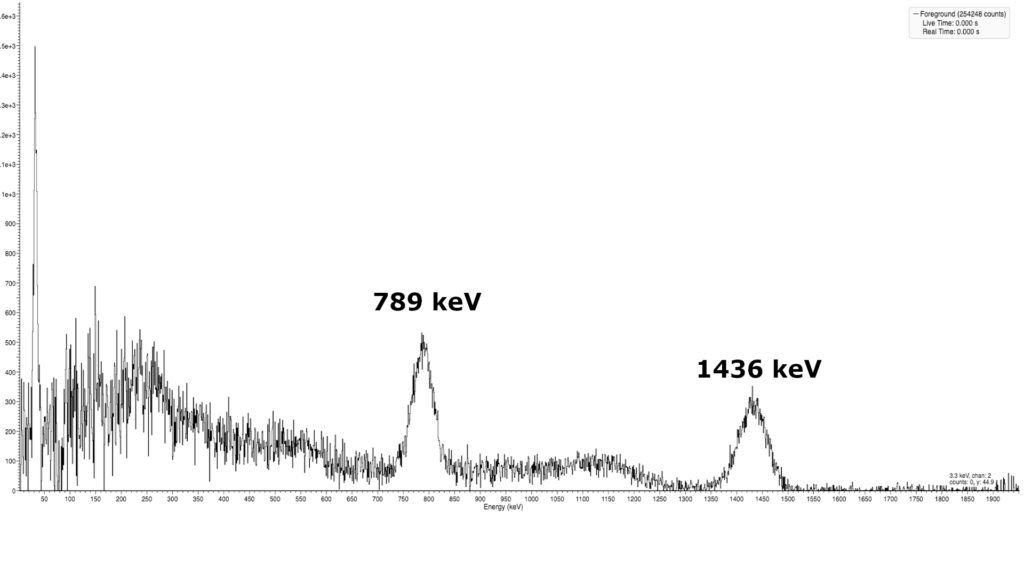
Lanthanum 138 decays through electron capture or by beta emission and in both cases, it also releases a gamma-ray at 789 keV and 1436 keV.
A gamma spectroscopy reviels two peaks at 789 keV and 1436 keV which are both caused by the decay of Lanthanum 138 through electron capture or by beta emission and in both cases a gamma ray is also released.
Cobalt 60 is a radioactive isotope of Cobalt and it is produced by neutron activation of stable Cobalt 59 in nuclear reactors. Since it has a short half-life of only 5.3 years, it does not occur in nature and all samples that exist are synthetic. A single gram of Co-60 has an activity of 44TBq and it undergoes a beta decay into an excited state of Nickel 60 which emits two gamma rays at 1173 and 1332 keV before becoming stable.
Gamma spectroscopy of Cobalt 60
One of the main uses of Cobalt 60 is in radiotherapy where cancer cells are exposed to a beam of high energy gamma radiation, effectively killing them. Its gamma rays are also used in the sterilisation of food and medical equipment and they can even be used in levelling devices and thickness gauges to detect structural errors.
Bomac 1B63A Waveguide Tube
For decades tubes have been a key component of electrical devices such as radios, amplifiers and many more. Some of these tubes contained radioactive elements which improved the ionisation process and also made them radioactive.
My sample of Co-60 is in an old Bomac 1B63A tube which was originally used in radars and it contained <1uCi of Co-60. These tubes have been manufactured in the late XX century and sadly there is no detectable activity left since almost all of Co-60 has decayed.
Dirty nukes
Unfortunately, Cobalt 60 can also be used in weapons of mass destruction. Dirty nukes or salty nukes are nuclear weapons that contain Cobalt 59 but during nuclear fission, it turns into Cobalt 60 which contaminates the surrounding area for decades. Officially, there are no countries in possession of such weapons and let’s hope that even if there are, they will never use them.
Donate
If you would like to support my work financially, feel free to buy me a nice cup of radioactive coffee.
In the 1940s, scientists and lens designers at Kodak, a world-famous camera and filmmaker, started experimenting with mixing rare earth elements into their lenses. After a series of tests, they found out that by adding Thorium 232 to lenses they can improve the quality of images produced. Not long after, other companies followed and as a result, many vintage lenses produced between the 1940s-1970s contain Thorium which makes them radioactive.
Kodak M18 Instamatic
Very popular, hand-held camera which was manufactured between 1967 and 1969 and it has a small Thorium lens inside.
WhyThorium?
Thorium oxide (ThO2) was added to lenses due to its optical properties such as high refractivity and low dispersion which allowed to minimize chromatic aberration. Some companies experimented also with Lanthanum, however, these lenses weren’t so widely manufactured as Throium lenses and they don’t have significant activity since only a very small percentage of natural Lanthanum is radioactive.
Radiation levels
These lenses often are pretty spicy in terms of radioactivity which can sound scary first but in reality, they are 100% safe to use unless you grind the thoriated glass into a powder and inhale it or eat it. Thorium and its decay products emit alpha beta and gamma radiation. Alpha and beta particles are easily stopped by the glass itself as well as the metal body however there is a small amount of gamma leaking through. So should we be worried? Not at all! The amount of gamma radiation leaking from the lens is actually smaller than standing on granite bricks. This being said, I wouldn’t leave the lens mounted on a camera for long periods of time simply to reduce radiation exposure to the sensor.
Takumar SMC f/1.8 55mm
A fantastic lens which can be found for not a lot of money. It is worth mentioning that not all of these lenses contain Thorium so finding one that does is a lottery.
Yellowing of radioactive lenses
One of the most characteristic features of radioactive lenses besides their radioactivity is their yellowed glass. The reason why the glass in Thoriated lenses has a slightly yellowish/brownish tint is simply because of radiation coming from the Th232 alternating atomic structure of glass. This yellowing can be easily reversed by exposing the lens for few hours to a UV light but I personally do enjoy the tint so I will leave my lens as it is.
While yellowed glass is a good indicator for a lens being radioactive, it is not always true. As mentioned earlier, some people restore their lenses to their original form, also during my research I also have found some yellowed lenses that did not contain Thorium. If you want to buy a radioactive lens I would suggest visiting your local flea market and bringing a small Geiger counter with you or doing a lot of research on different lens models and comparing the serial numbers with lenses known to be hot.
Gamma spectroscopy of the Takumar SMC f/1.8 55mm radioactive lens
As expected, gamma spectroscopy of the Takumar SMC lens clearly shows the presence of thorium and its decay products.
On July 16th, 1945 the United States tested its first nuclear weapon at the Trinity test site located in the Nevada desert, New Mexico. The bomb tested there was called the Gadget and it was a prototype of a Plutonium implosion-type bomb, similar to the one which was dropped on Nagasaki (Fat-Man).
Trinity test
When the Gadget exploded, the intense heat caused the steel tower, as well as surrounding sand to melt and form what we now call Trinitite.
Today, it is illegal to take Trinitite from the test site but you can buy it from different sellers online, who have collected it before the ban.
Different types of Trinitite
Trinitite comes in three different colours. The most common is green, a little bit rarer is red which contains copper from the wiring inside of the Gadget and finally black, which is the rarest and it contains iron from the steel tower on which the Gadget was placed.
Trinitite has a very low activity. When put together, my samples measured at around 110 cpm with a Pancake probe.
Trinitite sample under a microscope. You can see little bobbles containing air from 1945!
Fake trinitite & gamma spectroscopy of a real sample
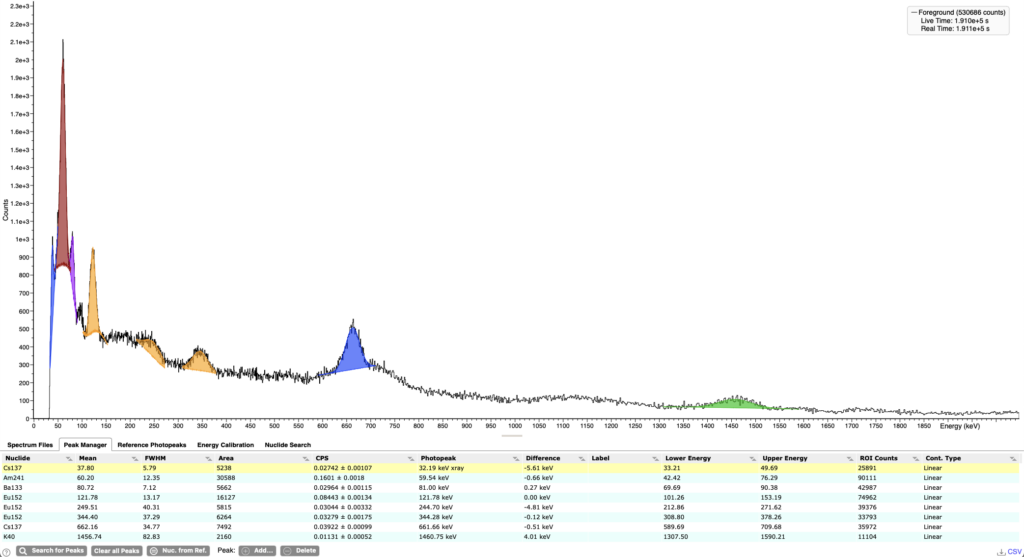
Unfortunately, the rise in demand for Trinitite caused some scammers to start selling fake samples. They make them by mixing sand with radioactive isotopes such as 90Sr and then heating it to extreme temperatures. As a result, they create glass that is very similar in looks to Trinitite and even is slighly radioactive. In order to verify if the sample is real or not, it is best to do gamma spectroscopy of it. A spectrum of a real Trinitite should show the following isotopes 241Am (59 keV),133Ba (81 keV), 152Eu (123 keV, 245 keV, 344 keV), 137Cs (31 keV, 662 keV) and 60Co (1173 keV, 1332 keV).
Gamma spectroscopy using RAYSID gamma spectrometer with a 5cm3 CsI(Tl) crystal
Uranium and Thorium along with Potassium are the most common, naturally occurring radioactive isotopes but there are also many other, lesser-known ones. One of them is Lutetium, which will be today’s main topic.
Lutetium is the last element in the Lanthanide series and it has been discovered in 1907 by French scientist Georges Urbain. Today Lutetium has very little commercial use due to its difficult production and high price but one of the uses is in the production of scintillation crystals which are used in positron emission tomography.
LYSO crystal
In nature, there are two isotopes of lutetium, 175Lu and 176Lu. Lutetium 176 is radioactive and it decays by a Beta emission into Hafnium 176 with a half-life of 37.8 billion (3.78×10¹⁰) years. Since Lutetium has a very long half-life, it is used in Lutetium-Hafnium dating of meteorites.
Lutetium has small, but detectible activity. My sample, which an LYSO crystal, measures 16 CPS above background on my RAYSID which has a [5cm3 (CsI(Tl) crystal]. Such activity is more than enough for gamma spectroscopy but it is not for measuring with a Geiger counter.
Lutetium has a very interesting gamma spectrum, it emits two gamma rays (202 keV and 307 keV) but since they are emitted at the exact same time, they sum up and form a peak at 509 keV.
176Lu gamma spectrum
Another use of lutecium is in the treatment of prostate cancer where a synthetic isotope of lutetium, 177Lu, is injected into patient’s body where it irradiates and kills cancer cells. Lutetium 177 emits two gamma rays at 113 keV and 208 keV.
Small amounts of radioactive isotopes are often used in common household items. A good example of that would be 241Am in smoke alarms or 226Ra in watches but today, I want to focus on tubes (valves) and other less common electrical components containing radioactive isotopes!
TG-36 Spark Gap Tube
Isotope: 137Cs
Activity originally: <1 uCi
TG-36 is a spark gap tube most probably produced in the late 1960s or early 1970s and it originally contained around 1 uCi (37 kBq) of 137Cs. Even though some 137Cs has decayed, it is still active enough so that it can be used as a calibration source for gamma spectroscopy as well as a check source for Geiger counters. When placed right against my RAYSID gamma spectrometer with a CsI(Tl) 5cm3 crystal, the activity increased by 218 CPS.
Bomac 1B63A Waveguide Tube
Isotope: 60Co
Activity (originally): <1 uCi
1B63A tube contains a small amount of 60Co which was used to better ionise the gas inside of the tube. Originally these tubes contained 1 uCi of Cobalt-60, however, Cobalt-60 has a rather short half-life of only 5.3 years, which means that there is less than 0.013 uCi left which means that there is no detectable activity. A gamma spectrum of Cobalt-60 should show two characteristic peaks at 1173 keV and 1332 keV.
DV3A Voltage Regulator Tube
Isotope: 63Ni
Activity: not detectable
Victoreen’s DV3A is a voltage regulator tube containing a microscopic amount of 63Ni. These tubes can be found in some old US survey meters from the cold war. I found mine in my Eberline 120 survey meter that I have bought some time ago without even knowing the tube contained any radioactive isotopes! Unfortunately, 63Ni emits only weak beta radiation which is not able to go through the glass tube and even if it would, the amount of 63Ni is too small to be detected.
2x2a Rectifier Tube
Isotope: None
Activity: None
While this tube does not contain any radioactive isotopes it can generate x-rays if hooked to a high voltage. Sadly, I don’t own a power supply capable of generating high voltage so I won’t be able to demonstrate it. Maybe one day…
AZS Switch
Isotope: 226Ra
Activity: 17.1k CPM (STS-5)
AZS switches were often used in different vehicles such as tanks and military planes produced in the Warsaw pact. The tip of the switch has radium 226 paint on it in order to make it glow in the dark but it also causes it to be very radioactive and emit huge amounts of radon since most of these switches are not sealed as a result of their age. It is worth mentioning that newer AZS have a non-radioactive, glow in the dark paint. An easy way to check if the switch contains 226Ra is simply to check if it glows in the dark. If NOT, then it is most probably radium.
BH-45M
Isotope: 226Ra
Activity: 200k CPM (LND 7311)
BH-45M is very similar to the above mentioned AZS with the main difference being a slightly smaller activity.
Wait, there is more!
If you know of any interesting tubes, switches and other electrical components containing radioactive isotopes, let me know in the comments section and I’ll do my best to get them and add them to the post!
We use cookies to ensure that we give you the best experience on our website. If you continue to use this site we will assume that you are happy with it.Ok