On July 16th, 1945 the United States tested its first nuclear weapon at the Trinity test site located in the Nevada desert, New Mexico. The bomb tested there was called the Gadget and it was a prototype of a Plutonium implosion-type bomb, similar to the one which was dropped on Nagasaki (Fat-Man).
Trinity test
When the Gadget exploded, the intense heat caused the steel tower, as well as surrounding sand to melt and form what we now call Trinitite.
Today, it is illegal to take Trinitite from the test site but you can buy it from different sellers online, who have collected it before the ban.
Different types of Trinitite
Trinitite comes in three different colours. The most common is green, a little bit rarer is red which contains copper from the wiring inside of the Gadget and finally black, which is the rarest and it contains iron from the steel tower on which the Gadget was placed.
Trinitite has a very low activity. When put together, my samples measured at around 110 cpm with a Pancake probe.
Trinitite sample under a microscope. You can see little bobbles containing air from 1945!
Fake trinitite & gamma spectroscopy of a real sample
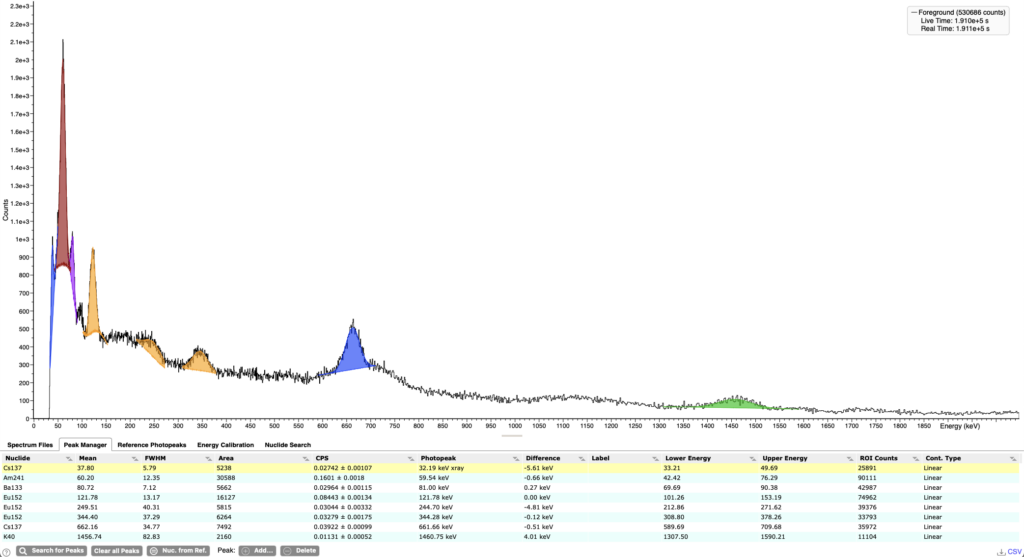
Unfortunately, the rise in demand for Trinitite caused some scammers to start selling fake samples. They make them by mixing sand with radioactive isotopes such as 90Sr and then heating it to extreme temperatures. As a result, they create glass that is very similar in looks to Trinitite and even is slighly radioactive. In order to verify if the sample is real or not, it is best to do gamma spectroscopy of it. A spectrum of a real Trinitite should show the following isotopes 241Am (59 keV),133Ba (81 keV), 152Eu (123 keV, 245 keV, 344 keV), 137Cs (31 keV, 662 keV) and 60Co (1173 keV, 1332 keV).
Gamma spectroscopy using RAYSID gamma spectrometer with a 5cm3 CsI(Tl) crystal
Uranium and Thorium along with Potassium are the most common, naturally occurring radioactive isotopes but there are also many other, lesser-known ones. One of them is Lutetium, which will be today’s main topic.
Lutetium is the last element in the Lanthanide series and it has been discovered in 1907 by French scientist Georges Urbain. Today Lutetium has very little commercial use due to its difficult production and high price but one of the uses is in the production of scintillation crystals which are used in positron emission tomography.
LYSO crystal
In nature, there are two isotopes of lutetium, 175Lu and 176Lu. Lutetium 176 is radioactive and it decays by a Beta emission into Hafnium 176 with a half-life of 37.8 billion (3.78×10¹⁰) years. Since Lutetium has a very long half-life, it is used in Lutetium-Hafnium dating of meteorites.
Lutetium has small, but detectible activity. My sample, which an LYSO crystal, measures 16 CPS above background on my RAYSID which has a [5cm3 (CsI(Tl) crystal]. Such activity is more than enough for gamma spectroscopy but it is not for measuring with a Geiger counter.
Lutetium has a very interesting gamma spectrum, it emits two gamma rays (202 keV and 307 keV) but since they are emitted at the exact same time, they sum up and form a peak at 509 keV.
176Lu gamma spectrum
Another use of lutecium is in the treatment of prostate cancer where a synthetic isotope of lutetium, 177Lu, is injected into patient’s body where it irradiates and kills cancer cells. Lutetium 177 emits two gamma rays at 113 keV and 208 keV.
Small amounts of radioactive isotopes are often used in common household items. A good example of that would be 241Am in smoke alarms or 226Ra in watches but today, I want to focus on tubes (valves) and other less common electrical components containing radioactive isotopes!
TG-36 Spark Gap Tube
Isotope: 137Cs
Activity originally: <1 uCi
TG-36 is a spark gap tube most probably produced in the late 1960s or early 1970s and it originally contained around 1 uCi (37 kBq) of 137Cs. Even though some 137Cs has decayed, it is still active enough so that it can be used as a calibration source for gamma spectroscopy as well as a check source for Geiger counters. When placed right against my RAYSID gamma spectrometer with a CsI(Tl) 5cm3 crystal, the activity increased by 218 CPS.
Bomac 1B63A Waveguide Tube
Isotope: 60Co
Activity (originally): <1 uCi
1B63A tube contains a small amount of 60Co which was used to better ionise the gas inside of the tube. Originally these tubes contained 1 uCi of Cobalt-60, however, Cobalt-60 has a rather short half-life of only 5.3 years, which means that there is less than 0.013 uCi left which means that there is no detectable activity. A gamma spectrum of Cobalt-60 should show two characteristic peaks at 1173 keV and 1332 keV.
DV3A Voltage Regulator Tube
Isotope: 63Ni
Activity: not detectable
Victoreen’s DV3A is a voltage regulator tube containing a microscopic amount of 63Ni. These tubes can be found in some old US survey meters from the cold war. I found mine in my Eberline 120 survey meter that I have bought some time ago without even knowing the tube contained any radioactive isotopes! Unfortunately, 63Ni emits only weak beta radiation which is not able to go through the glass tube and even if it would, the amount of 63Ni is too small to be detected.
2x2a Rectifier Tube
Isotope: None
Activity: None
While this tube does not contain any radioactive isotopes it can generate x-rays if hooked to a high voltage. Sadly, I don’t own a power supply capable of generating high voltage so I won’t be able to demonstrate it. Maybe one day…
AZS Switch
Isotope: 226Ra
Activity: 17.1k CPM (STS-5)
AZS switches were often used in different vehicles such as tanks and military planes produced in the Warsaw pact. The tip of the switch has radium 226 paint on it in order to make it glow in the dark but it also causes it to be very radioactive and emit huge amounts of radon since most of these switches are not sealed as a result of their age. It is worth mentioning that newer AZS have a non-radioactive, glow in the dark paint. An easy way to check if the switch contains 226Ra is simply to check if it glows in the dark. If NOT, then it is most probably radium.
BH-45M
Isotope: 226Ra
Activity: 200k CPM (LND 7311)
BH-45M is very similar to the above mentioned AZS with the main difference being a slightly smaller activity.
Wait, there is more!
If you know of any interesting tubes, switches and other electrical components containing radioactive isotopes, let me know in the comments section and I’ll do my best to get them and add them to the post!
Items generating “Negative Ions” are no strangers to this channel. In fact, my first proper video was on one of them! Today we take a closer look at another pendant but this one is pretty special!
Unlike the old pendant, this one is made out of green glass which also glows under black light and is radioactive so my first assumption was that it must be uranium glass.
Uranium glass (aka vaseline glass) was produced mainly during the age of atomic madness however because of the nuclear weapons, people got scared of radiation and as a result, they stopped buying products containing uranium. Today, Uranium glass can be mainly found in antique shops but also in the Czech Republic because it is one of the very few countries producing Uranium glass!
Uranium glass under the black light
Anyhow, back to the pendant. My first guess was that it was made out of Uranium glass but just to be sure, I did gamma spectroscopy of it. To my surprise, gamma spectroscopy revealed that the pendant did not contain uranium but Thorium meaning that this Thorium glass! When compared to Uranium glass, Thorium glass looks a little bit darker and it doesn’t glow so brightly under black light. It is also much more radioactive (U-Glass X CPM, Th-Glass 3 000 CPM)
Mysterious Green Glass Pendant Gamma Spectrum.
After making a video on my first negatrive ion pendant, many people pointed out to me that the authenticity card is also radioactive but sadly I could not detect anything. Who knows, maybe they are running out of Thorium?
If you got any suggestions for future post, feel free to post them in the comments section below!
Today we will take a closer look at an element that you most probably did not know was radioactive, Bismuth.
Bismuth was first discovered in 1753 and is probably most famous for its very characteristic crystal structure and absolutely stunning colours. In nature, it has only one isotope, 209Bi, which is also one of the primordial elements.
Primordial elements are elements that have existed in their current form before the Earth was formed. As of right now, there are 252 stable and 34 radioactive primordial isotopes.
Bismuth crystal
From the moment of its discovery, scientists believed that Bismuth was a stable element but in 2003, it was found out that Bismuth 209 undergoes alpha decay into Thallium 205 with a half-life of 2.01×10¹⁹ years which is over 1 billion times the age of the universe! The reason why Bismuth’s radioactivity was discovered so late is because of its very low activity, 3 Bq/1000kg, making it extremely hard to detect. Due to an extremely long half-life and very low activity, Bismuth is often treated as a non-radioactive element.
Today, Bismuth is mainly used in the production of cosmetics and medicine so theoretically, every time you apply makeup, you put radioactive material on your face!
Today I want to show you an element that made the use of radium 226 in paint absolute! Let’s take a closer look at Hydrogen 3 or better known as Tritium!
Tritium marker
Tritium is a radioactive isotope of Hydrogen with 2 neutrons which makes it unstable and thus radioactive. It was first discovered in 1934 by a group of three scientists, Ernest Rutherford, Mark Oliphant and Paul Harteck who have bombarded deuterium with high-energy deuterons which resulted in the creation of Tritium.
Today, Tritium is most often produced in nuclear reactors by neutron activation of Lithium-6. As a result, Lithium turns into Helium and Tritium
Tritium has a half-life of 12.32 years and it decays by beta radiation (5.7keV) and in the process, it also releases a gamma-ray (18.6keV). Since the energy of both beta and gamma radiation is so low, tritium can be safely used in consumer products.
Radiation coming from the Tritium marker isn’t directly caused by the Tritium itself. The beta particles don’t have enough energy to pass through the plastic and are stoped by it. This however causes Bremsstrahlung (X-Rays) which is then detected by the Geiger counter.
Until the 1960s, many watch manufactures used Radium paint in order to make the dials glow in the dark. However, Radium 226 is very dangerous and because of this it was banned and was replaced by Tritium which has similar radio-luminescence properties but is much safer to use.
Adrianov’s Compass with Radium 226 paint
The most common use for Tritium is in the production of radio-luminescent markers that are used in watches, gun sights. and emergency exit signs. The radio-luminescence is achieved by coating the Tritium vial with a layer of phosphor from the inside. When beta particles hit phosphor, they cause it to fluoresce releasing visible light.
Tritium Watch
Tritium Gun Sights
Tritium Exit Sign
Since Tritium has a half-life of 12.32 years, these markers will remain glowing for over 10 years depending on how much tritium there is in them.
Tritium can also be used as a nuclear battery generating electricity by converting energy from beta radiation. Many scientists claim that this technology is the future for deep space exploration where sunlight is too weak to generate enough electricity to power a spacecraft.
Tritium battery
The MARS 2020 Perseverance rover already runs on a similar kind of battery which uses Plutonium 238 and I am sure that we will see more nuclear batteries in the future!
On the 26th of April, 1986, reactor number 4 at Chernobyl Nuclear Power Plant exploded. As a result, a large amount of radioactive isotopes was released into the environment contaminating most of eastern Europe.
Today, 35 years later, most radioactive isotopes with short half-life have decayed with only 6 isotopes remaining in significant amounts from which Caesium 137 and Strontium 90 make the top of the list.
Recently, my good friend was in Belarus and during his trip, he collected some local mushrooms.
Why do I bring this up? Because mushrooms, particularly bay boletes, accumulate heavy metals. This means that if they grew in an area contaminated by radioactive fallout then there should be a detectible amount of Caesium 137 in them.
Belarusian mushrooms
When measured with Ludlum Model 3 Survey Meter with a Johnson Pancake probe, the reading was around 150CPM which is over 3x the normal background radiation.
In order to make sure that the activity coming from these mushrooms is caused by Chernobyl fallout, I did a Gamma spectroscopy using RAYSID gamma spectrometer.
After a few minutes, a narrow peak started to form at 662keV, which is very characteristic for Caesium 137 which means that these mushrooms are contaminated by nuclear fallout from Chernobyl.
Gamma spectroscopy of the radioactive mushrooms (without lead castle)
Since I am not an expert, I can not tell you whether or not eating such mushrooms is safe but if you ask me, I do prefer non-radioactive ones!
Ok, this one was on my to-do list for a very long period of time. Today I’ll show you the most radioactive Geiger counter the world has ever seen. Let’s take a closer look at the DP-63-A.
The DP-63-A is a high range Geiger counter designed to detect contamination after a nuclear attack or an accident. It has two measuring ranges, 1.5 R/h and 50 R/h. The 1.5 R/h range uses the upper scale and 50 R/h range uses the bottom scale. In order to take a measurement, we must hold the 1.5 R/h or 50 R/h button that is located on the right side. Holding both buttons at the same time will result in a circuit test. This unit is equipped with 2x Geiger Muller tubes, one for the lower range and the other for the higher. DP-63-A also has a beta window which allows measuring beta+gamma or gamma only. Since these are high range Geiger counters, I don’t think there are very practical, unless you are planning on going inside of CNPP reactor 4.
DP-63-A from 1965
These units were produced during the Cold war from 1958 until the 1970s. What makes them really interesting is the fact that the models produced from 1958 to 1966 used radium (Ra-226) paint on the scale. This was done in order to make the scale glow in the dark environment, however, it also resulted in the meter itself being extremely radioactive. Today the scale doesn’t glow at all even when light-up using a black light.
Very radioactive radium scale
It seems that there are two versions of the radioactive DP-63-A. The early models had little bit more radium paint on them making them “hotter”. Few years after the production has started, the amount of radium paint was reduced in order to make the DP-63-As “safer” but they were still stupidly radioactive! These two versions can be easily told apart. The “hotter” units have a year of production written on the front panel, while the less radioactive ones have only the serial number. My unit is the “hotter” one.
Units produced after 1966 used luminance paint but it wasn’t radioactive like on early units. Unfortunately, units without radium scale look almost identical to the units with less radium paint. This makes finding a DP-63-A with radium scale more challenging.
Sadly, no radium paint
DP-63-A produced after 1966
My first shot at getting DP-63-A with radium scale was unfortunately unsuccessful. Luckily I managed to return it and I started looking for another unit but with radium scale.
After some time, I found an auction with DP-63-A from 1965. I reached out to the seller and ask him if the unit was factory sealed. Unfortunately, it was opened by someone else in the past but I still decided to pull the trigger after I got a really good deal on it.
When the packaged arrived I immediately knew that I got a unit with a radium scale since my Geiger counter was screaming when it was anywhere near the box.
Radioactive package
After opening the box, I knew I had to remove the radium scale from the unit and put it into a lead pig for safety reasons before I could make a more detailed video on this Geiger counter.
Removing radium scale from DP-63-A
Although I removed all radioactive source, the unit was still radioactive. That was because radium 226 decays into radon 222 which is a gas, meaning the inside of the unit was heavily contaminated. I used a water sprayer in order to wash out as much contamination as I could. Unfortunately, radon decay products tend to “stick” to different surfaces which meant that even after a lot of decontaminating, the unit was still radioactive but luckily nowhere near the levels when I first opened it.
Inside of the unit, there are two Geiger Muller tubes but what is interesting, is the use of B-8 Strontium 90 Source (click here). You may ask why is there a check source right under Geiger-Muller tubes. Well, this is a great example of soviet engineering. If you look at the front scale you can see that the upper scale (1.5 R/h) has 0 in a different place than the lower scale (50 R/h). In order to compensate the 0 position, a strontium 90 was used to raise the needle slightly when using 1.5 R/h scales. The B-8 strontium 90 source reads around 1 mSv/h (1026 uSv/h) on the Terra-P when measured right next to SBM-20 GMT.
Strontium 90 source
Now, let’s talk about the other check source this unit has to offer, the DP-63-A’s legendary radium scale. On first glance, it doesn’t look like radium paint. It has a white, slightly creams colour while usually, radium paint has a brown/dark orange colour.
The layer of radium paint is very thick making the scale insanely radioactive. When measured with my Terra-P, the readings seemed to be around 3.5 mSv/h which is around 3500uSv/h of beta+gamma and gamma only was 420uSv/h! These are some very scary numbers. Just to give you some perspective, on average, a human receives 3-5 mSv/year from natural background radiation. Just for fun I also measured the scale with my Ludlum Model 3 with alpha/beta/gamma SBT-11A tube. Even though I was on the x100 scale, Ludlum got maxed out instantly at over 500 000 CPM.
Radium scale
TerraP over the radium scale
In order to store this radium scale safely, I put it inside of a plastic bag which I then put inside of another plastic bag which I then put into a glass jar which I finally put inside of a lead pig container. The reason why I used a glass jar is to prevent radon 222 from leaking out. As the result, I managed to reduce gamma radiation from 420uSv/h to only around 8 uSv/h. I’ve also used the rule of inversed square law and placed the lead pig with radium scale as far away as possible. At a distance of one meter, the dose dropped to the normal background when measured with my RAYSID gamma scintillator/spectrometer (click here).
Overall, the only reason why I would recommend this Geiger counter to anyone is for its two, strong check sources. This being said, I highly discourage anyone from opening this unit or removing the radium scale since it is extremely dangerous!
Hi, I have finally received my Quantum Scalar Energy pendant. Inside the box there was a card of authenticity and of course, the medalion which will be the main focus of this post.
Slightly radioactive package
The pendant is made from lava stone which has a really nice mat-black colour. There is also a rubber ring around it for additional protection.
What I did find interesting, is the fact that this medalion appeared to be radioactive, but why?
In order to find out, I used RAYSID gamma spectrometer for isotope identification. Here is spectrum after 4h and 15 minutes. As we can see, RaysID automatcly identified different energy peaks.
4h 15min gamma spectrum
Here is the same spectrum but with my annotations. All peaks detected by RaysID seem to be within 1% error range. Very impressive considering RAYSID size.
4h 15min gamma spectrum with annotations
The peak on the left, at 78 kev comes from X-ray flourence. There are two peaks from Actinium 228 at 129 kev and 338 kev. The peak in the middle at 238kev is from Lead 212 and the peak at 583 kev from Thallium 208. Unfortunately I wasn’t able to identify peaks at 43 kev and 682 kev.
The isotopes detected are daughters of Thorium 232 and as we can see RAYSID already informs us about possible Thorium content.
Conclusion: Traces of thorium can be found in lava which can make it slightly radioactive.
We use cookies to ensure that we give you the best experience on our website. If you continue to use this site we will assume that you are happy with it.Ok