Exploring the Fascinating Radioactivity of Lutetium-176 (and Lutetium-177)

Exploring Naturally Radioactive Elements – Lutetium 176

Welcome back my fellow radiation nerds!

When we think of naturally occurring radioactive elements we mainly think of Uranium and Thorium and maybe sometimes Potassium. While those elements are the most common ones, there are many others that also have naturally radioactive isotopes. However, most of them have very long half-lives making them extremely hard to detect, especially without specialised equipment, but there are a few that can be measured with a sensitive Geiger Counter or Scintillation detector. One of them is Lutetium with its radioactive isotope of Lutetium 176.

If you enjoy this content make sure to subscribe to the channel so you don’t miss any of the upcoming uploads. Thanks and now back to the video!

The Discovery

Lutetium has been discovered independently by three scientists in the year 1907, a French scientist George Urbain, Austrian mineralogist Carl Auer von Welsbach, which you might also know as the inventor of Thoriated gas mantles, and American chemist Charles James. After years of dispute, George Urbain has been named by the scientific community as the discoverer of the new element and he named it Lutetium after Lutetia, the ancient Roman name for the city of Paris.

George Urbain
Carl Auer von Welsbach
Charles James

Properties of Lutetium

Lutetium is a rare earth element with an atomic number of 71. It is the last element in the Lanthanide series and it shares many of the chemical properties with other elements in the group. In nature, it has only 2 isotopes, a stable Lutetium 175 (97.4%) and a radioactive Lutetium 176 (2.60%).

Lutetium 176 undergoes a beta decay with an average energy of 182 keV, turning into Hafnium 176 with a half-life of 37.8 Billion (3.78e10) years, and in the process it also emits gamma rays at 88, 202 and 307 keV. What is Interesting about Lutetium 176 is that the both gamma rays of 202 and 307 keV are emitted in coincidence with each other, forming summing peak at 509keV

RAYSID Gamma Spectrometer (<7% at 662keV resolution)

Uses of Lutetium

Today Lutetium doesn’t see much use due to its difficult production and very high costs but it can be found in some specialised fields. One of its main uses is in the production of scintillation crystals which are used in positron emission tomography (PET) scans.

It can also be found in some alloys like in the case of like LuAG where it improves the overall durability and heat resistance of the material.

And thanks to its long half-life, Lutetium 176 can be used for Lutetium-hafnium dating of meteorites.

My samples & their radioactivity

At the moment, I have two types of Lutetium samples. The first one is a form of LYSO scintillation crystals which I got from a friend of mine (thanks James!), I have linked his eBay store in the description below in case you want to grab one for yourself.

James Ebay Store

When measured with SE International Ranger which uses a LND7317 Pancake type tube, I got from a single crystal 73 CPM, only 30 CPM over the background radiation. When measured with my RAYSID I got an increase of 15 CPS in the activity which is more than enough to build a gamma spectrum, however a good lead castle to minimise background radiation is definitely a good idea.

As mentioned before, these crystals are used in positron emission tomography (PET) and when exposed to radiation they glow in a light blue colour.

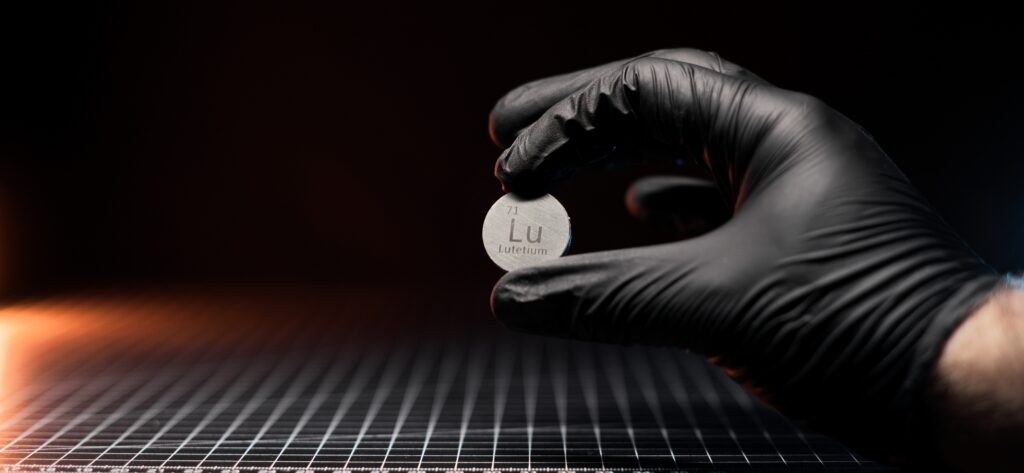
My second sample is a metal coin made out of pure Lutetium metal which measures 24.26 mm x 1.75 mm and weighs about 8.43g, this means it contains around 0.218g of pure Lu176 that has activity of approximately ~432 Bq. Compared to the LYSO crystal, the activity is a bit higher and reads on my Ranger 160 CPM above background and 55 CPS on my RAYSID.

Since the coin is made of pure metal, it is much denser than the LYSO crystal and some of the activity gets self shielded which results in the readings being a big lower than expected.

Since I use it as my main Lu-176 source for gamma spectroscopy, I decided to put it in a 1″ plastic disk with a label stylised a bit after other professional calibration sources. While it might be a bit goofy or silly to some, I do enjoy a consistent look of my sources and I’m very happy with the results.
Isotope Lutetium 177

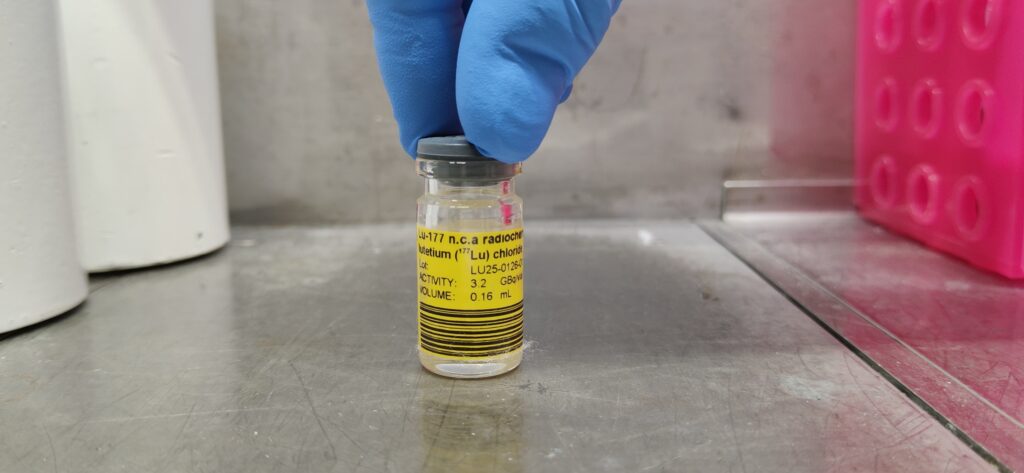
In nuclear medicine, a synthetic isotope of Lutetium, Lu-177 is used in targeted cancer therapy. It is produced by neutron irradiation of Lu176 and it decays through a beta emission into Hafnium 177 with a half-life of 6.65 days and it emits two gamma rays at 113 keV and 208 keV.

A good friend of mine works in a nuclear lab and recently they received a fresh batch of Lu177 for their experiments and he was kind enough to make some videos showcasing the samples, testing them against some of his meters and take a gamma spectrum of them. Big Thanks for the help!

Originally this vial contained 3.2GBq of Lu-177 in form of Lutetium Chloride solution, however most of it has been already removed and now there are only traces of Lu-177 left. Despite that, the vial still read pretty high on the RadEye B20 with over 60k CPM and registered 760uSv/h on the RAYSID.
Summary

Exploring the radioactivity and the history of Lutetium and its isotopes was definitely a great experience and I have learned a lot about it. I want to hear from you, did you know about the natural radioactivity of Lutetium and do you have any samples of it? What other radioactive elements should I cover next? Let me know in the comments below!


Thank you so much for reading this post, I hope you enjoyed it and learned something new! If yes, please make sure to subscribe to the email list so that you get notified when new posts are added. Also feel free to check out my Patron page where you can support the channel financially and get some additional exclusive content.

and remember, stay active!

Radioactive Contamination Found – Can We Identify It?

Welcome back my fellow radiation nerds! Today we will take a closer look at radioactive contamination inside of my lead pig container and try to identify the isotope behind it.

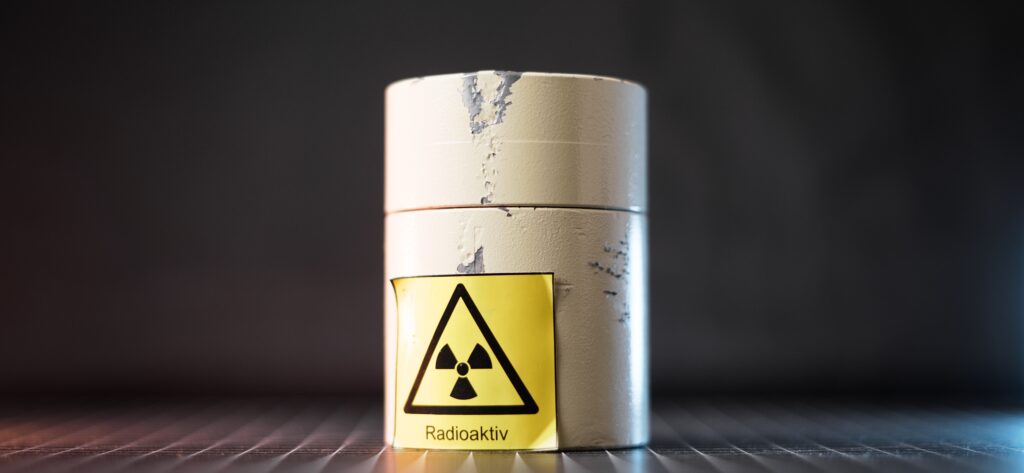
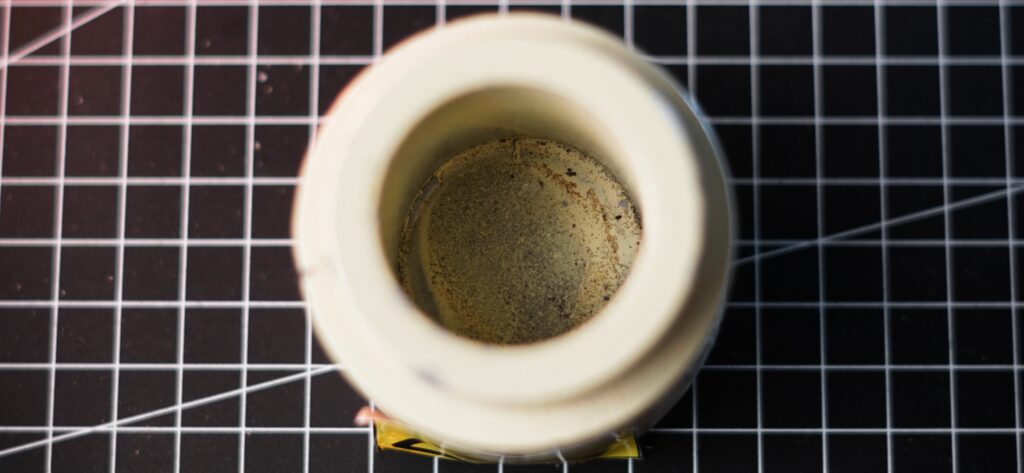
Lead pigs are lead containers used to store highly radioactive sources and shield their radiation to help minimise exposure. This one in particular originally came from one of the German nuclear power plants and it is made out of solid lead and weighs about 2kg. Although the container did not come with any radioactive sources, after unboxing the package, I noticed that the inside of the container emitted radioactivity and was most likely contaminated with some mysterious radioactive source.

This discovery was very exciting and I was very curious to find out what isotope was behind the contamination.

What are we dealing here with?

There plenty of different radioactive isotopes out there, some are natural such as Uranium and Thorium and their decay products, and some are man-made produced in nuclear reactors, in particle accelerators or during atomic tests.

In order to find out what isotope is behind the contamination, I need to narrow down my search and eliminate any isotopes that don’t match the characteristics and properties of the one inside the lead pig.

I’ll start by checking what type of radiation is being emitted from the container. First, I’m going take a measurement first without any shielding and then I’ll start introducing different materials to block out different types of radiation and compare the results. For this purpose I will use my Ludlum Model 3 with a 44-9 probe as it can easily detect alpha, beta and gamma radiation.

  • Alpha particles can travel in air up to 5cm and can be easily stopped with a thicker piece of paper.
  • Beta particles can travel up to half a meter in air and can go through low density materials but a piece of aluminium should be enough to block them.
  • Gamma rays can travel very long distances and are the hardest to shield requiring very dense materials such as Lead or sometimes even Uranium.

From my first measurement without any shielding and I got a result of about 1000 CPM at 1cm distance from the lead pig. After placing a piece of paper between the probe and the container, the result remained unchanged. This meant that there are pretty much no alphas being emitted by the source.

Next, I’ve added a piece of aluminium and the readings dropped significantly, all the way back to background levels meaning that the source was a primarily a beta emitter and even if there was some gamma radiation, it was extremely low and not detectable by my meter.

Gamma Spectroscopy

Although I haven’t detected any gamma radiation above background levels, I still decided to do a gamma spectroscopy with my RAYSID. Sometimes even trace amounts of gamma radiation are enough to build a good spectrum and identify different isotopes.

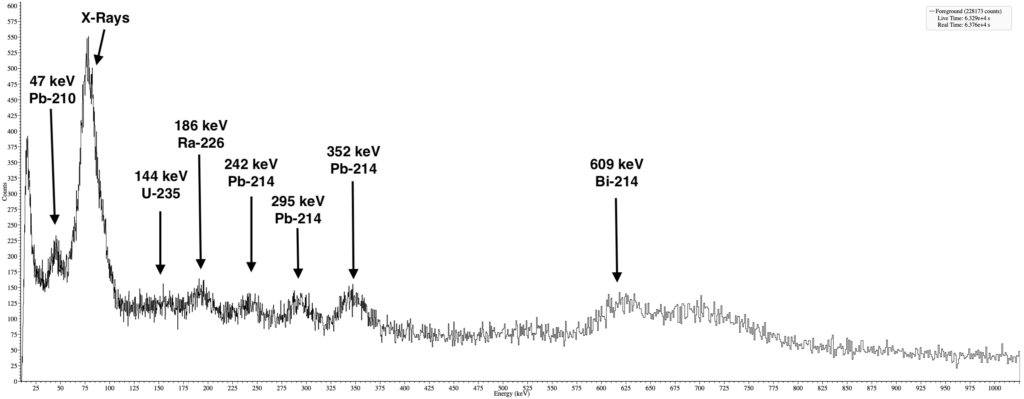
Inside my lead castle, the background activity is only 1.2 CPS when measured with my RAYSID. After placing the lead pig container inside, I got reading of 3.5 CPS and after collecting data for few hours, I managed to create a gamma spectrum of the lead pig.

The gamma spectroscopy revealed peaks that are characteristic for Uranium ore. I spoke with the previous owner and he did mention that he stored uranium ore inside so definitely there is a chance that a small piece broke off the mineral and is at the bottom of the container, however the amount of beta radiation compared to gamma could hint at another contaminant but unfortunately I don’t have the tools to properly check or identify it.

Conclusion

This is actually not the first time that I see a contaminated lab equipment. A friend of mine has a lead pig that is contaminated with radioactive Cs-137 as a result of a chemical spill inside of it.

I want to hear from you, did you ever find some contaminated lab gear and do you think the remains of Uranium ore are the only contamination inside of my lead pig or could there be some other radioactive isotope. I’m looking forward to hearing your suggestions and answers in the comments below.


Thank you so much for reading this post, I hope you enjoyed it and learned something new! If yes, please make sure to subscribe to the email list so that you get notified when new posts are added. Also feel free to check out my Ko-Fi page where you can donate a nice cup of radioactive coffee and support my work financially.

and remember, stay active!

Uranium in Fossils? Testing a Radioactive Megalodon Tooth

Welcome back, fellow radiation nerds! Today, we’re diving deep into the radioactivity of ancient dinosaur fossils!

My Sample

During my recent trip to US, I visited the Meteor Crater which was an absolute amazing experience. After the tour, I went to the souvenir shop where I spotted some Megalodon teeth. I heard before that sometimes they can be radioactive, so I quickly took out my Terra-P Geiger counter and I got very excited when my meter started showing increased levels of radiation. Of course, I couldn’t leave without taking one home, and here I am!

Gamma spectroscopy and the activity

I was curious to what isotope made the my tooth radioactive so I used my RAYSID gamma spectrometer, to create a gamma spectrum which revealed that the tooth contains natural uranium. While the activity isn’t particularly high compared to something like uranium ore, it is definitely detectable and reads just under 1000 CPM on my Ludlum Model 3 with a 44-9 probe at 1cm distance and around 0.5uSv/h on my RAYSID also at 1cm distance.

How does a fossil become radioactive?

During the process of fossilisation, organic material is being replaced with the surrounding minerals, and if those minerals are contain uranium, the fossil can absorb them and become radioactive over time.

This isn’t just limited to Megalodon teeth either—it can happen to all fossils. For example, at the Grants Mining Museum in New Mexico, there are several dinosaur fossils with significant radioactivity due to them being fossilised in a uranium-rich environment.

Speaking of the Grants Uranium Mining Museum, I highly recommend visiting it if you get a chance. There is a lot of fascinating information and exhibits in it and the underground tour was a truly unique experience. I used to be a guide in a Uranium mine and I found it particularly interesting to see how uranium mining techniques compared between America and Eastern Europe.

Radiometric dating of fossils and rocks

Thanks to the decay of radioactive isotopes, scientists can estimate the age of different fossils. This process is known as radiometric dating, and some of the most commonly used isotopes are:

Carbon 14 – Naturally occurs in all living organisms and has a half-life of 5730 years. When the organism dies, it stops the resupply of carbon which allows scientist to date samples up to 50 000 years old.

Potassium 40 – It has a half-life of 1.25 Billion years and just like Carbon 14, it naturally exists in all living organisms. Since the half-life of K-40 is much longer, it allows scientists to date samples that are million of years old.

Uranium 238 – This method is used for dating zircon crystals found in volcanic ash layers associated with fossils. Uranium isotopes decay to lead isotopes with a half-life of 4.47 billion years, making it ideal for dating ancient rocks.

A few final words

Exploring the radioactivity of my Megalodon fossilised tooth was a lot of fun and I have learned a lot!

I’m curious to hear, do you have any radioactive fossils in your collection or maybe you didn’t even know they can be radioactive and you will check them now? Let me know in the comments!


Thank you so much for reading this post, I hope you enjoyed it and learned something new! If yes, please make sure to subscribe to the email list so that you get notified when new posts are added. Also feel free to check out my Ko-Fi page where you can donate a nice cup of radioactive coffee and support my work financially.

and remember, stay active!

Radioactive Tungsten Electrodes (TIG)

Introduction

Today I want to show you an item that you can find in a hardware store and it is radioactive. Let’s take a closer look at the thoriated Tungsten electrodes!

Main information

There are three types of thoriated Tungsten electrodes with the only difference being the amount of Thorium in them. Yellow ones contain around 1% of Thorium, red contain 2% and orange contain 4%. Even though orange ones contain the highest amount of Thorium, they are actually not much more radioactive than the red ones which are the most common. Tungsten electrodes come in different sizes with the bigger ones being slightly more active. Personally, I decided to go with 3.2mm x 175mm but smaller should also work fine.

Red Tungsten Electrodes (WT20)

Isotope: 232Th

Activity: < CPM (LND 7311)

Amount: ~2%

Since the label on the box clearly states that these electrodes contain Thorium, I didn’t expected the gamma spectroscopy to show anything intresting but to my suprise, it did!

Slide to the right to see Thorium gas mantle spectrum
Slide to the Left to see Thoriated Tungsten electrodes spectrum

The main two differences between the spectrum of Tungsten electrodes and the spectrum of Thorium gas mantle are the peak at 511 keV and the peak 583 keV. Let’s start with the peak at 511 keV. It is referred to as annihilation peak and it is caused by the annihilation of a positron by its interaction with an electron. This event can occur more often in Tungsten electrodes because of their density. The peak at 583 keV is caused by Thallium 208. When Thorium decays, it emits Radon 220 which is a gas and it escapes into the air but in the case of the Tungsten electrodes, it is trapped by dense Tungsten which results in the accumulation of Radon decay products including Thallium 208.

Thorium decay chain (source: metadata.berkeley.edu)

Safety

These electrodes are often used as a check source because of how easy to find they are and their small activity which makes them relatively safe. That being said, when used for their original purpose, the dust generated by sharpening them could cause health problems in the long run if inhaled.

Fake Tungsten Electrodes

When buying these electrodes, make sure to buy branded ones because unfortunately, unbranded ones are often fake and they do not contain Thorium. I made this mistake twice and both times I received fake electrodes that weren’t radioactive.

Radioactive Vintage Lenses

In the 1940s, scientists and lens designers at Kodak, a world-famous camera and filmmaker, started experimenting with mixing rare earth elements into their lenses. After a series of tests, they found out that by adding Thorium 232 to lenses they can improve the quality of images produced. Not long after, other companies followed and as a result, many vintage lenses produced between the 1940s-1970s contain Thorium which makes them radioactive.

Kodak M18 Instamatic

Very popular, hand-held camera which was manufactured between 1967 and 1969 and it has a small Thorium lens inside.

Why Thorium?

Thorium oxide (ThO2) was added to lenses due to its optical properties such as high refractivity and low dispersion which allowed to minimize chromatic aberration. Some companies experimented also with Lanthanum, however, these lenses weren’t so widely manufactured as Throium lenses and they don’t have significant activity since only a very small percentage of natural Lanthanum is radioactive.

Radiation levels

These lenses often are pretty spicy in terms of radioactivity which can sound scary first but in reality, they are 100% safe to use unless you grind the thoriated glass into a powder and inhale it or eat it. Thorium and its decay products emit alpha beta and gamma radiation. Alpha and beta particles are easily stopped by the glass itself as well as the metal body however there is a small amount of gamma leaking through. So should we be worried? Not at all! The amount of gamma radiation leaking from the lens is actually smaller than standing on granite bricks. This being said, I wouldn’t leave the lens mounted on a camera for long periods of time simply to reduce radiation exposure to the sensor.

Takumar SMC f/1.8 55mm

A fantastic lens which can be found for not a lot of money. It is worth mentioning that not all of these lenses contain Thorium so finding one that does is a lottery.

Yellowing of radioactive lenses

One of the most characteristic features of radioactive lenses besides their radioactivity is their yellowed glass. The reason why the glass in Thoriated lenses has a slightly yellowish/brownish tint is simply because of radiation coming from the Th232 alternating atomic structure of glass. This yellowing can be easily reversed by exposing the lens for few hours to a UV light but I personally do enjoy the tint so I will leave my lens as it is.

While yellowed glass is a good indicator for a lens being radioactive, it is not always true. As mentioned earlier, some people restore their lenses to their original form, also during my research I also have found some yellowed lenses that did not contain Thorium. If you want to buy a radioactive lens I would suggest visiting your local flea market and bringing a small Geiger counter with you or doing a lot of research on different lens models and comparing the serial numbers with lenses known to be hot.

Gamma spectroscopy of the Takumar SMC f/1.8 55mm radioactive lens

As expected, gamma spectroscopy of the Takumar SMC lens clearly shows the presence of thorium and its decay products.

Extra links that might be useful

A list of radioactive lenses [Click Here]

A list of radioactive Takumar & Pentax lenses [Click Here]

Great YouTube video on radioactive lenses by “Simon’s utak” [Click Here]

A few photos shot on a Canon M50 with a K&F adapter and a radioactive Takumar SMC f/1.8 55mm lens.

All these photos were shot with a Canons standard picture style and no post processing except balancing the exposure in some cases

Tritium – The radioactive isotope of Hydrogen

Today I want to show you an element that made the use of radium 226 in paint absolute! Let’s take a closer look at Hydrogen 3 or better known as Tritium!

Tritium marker

Tritium is a radioactive isotope of Hydrogen with 2 neutrons which makes it unstable and thus radioactive. It was first discovered in 1934 by a group of three scientists, Ernest Rutherford, Mark Oliphant and Paul Harteck who have bombarded deuterium with high-energy deuterons which resulted in the creation of Tritium.

Today, Tritium is most often produced in nuclear reactors by neutron activation of Lithium-6. As a result, Lithium turns into Helium and Tritium

Tritium has a half-life of 12.32 years and it decays by beta radiation (5.7keV) and in the process, it also releases a gamma-ray (18.6keV). Since the energy of both beta and gamma radiation is so low, tritium can be safely used in consumer products.

Radiation coming from the Tritium marker isn’t directly caused by the Tritium itself. The beta particles don’t have enough energy to pass through the plastic and are stoped by it. This however causes Bremsstrahlung (X-Rays) which is then detected by the Geiger counter.

Until the 1960s, many watch manufactures used Radium paint in order to make the dials glow in the dark. However, Radium 226 is very dangerous and because of this it was banned and was replaced by Tritium which has similar radio-luminescence properties but is much safer to use.

Adrianov’s Compass with Radium 226 paint

The most common use for Tritium is in the production of radio-luminescent markers that are used in watches, gun sights. and emergency exit signs. The radio-luminescence is achieved by coating the Tritium vial with a layer of phosphor from the inside. When beta particles hit phosphor, they cause it to fluoresce releasing visible light.

Since Tritium has a half-life of 12.32 years, these markers will remain glowing for over 10 years depending on how much tritium there is in them.

Tritium can also be used as a nuclear battery generating electricity by converting energy from beta radiation. Many scientists claim that this technology is the future for deep space exploration where sunlight is too weak to generate enough electricity to power a spacecraft.

Tritium battery

The MARS 2020 Perseverance rover already runs on a similar kind of battery which uses Plutonium 238 and I am sure that we will see more nuclear batteries in the future!

Don’t like reading? Watch a video!

Chernobyl fallout in Mushrooms!

On the 26th of April, 1986, reactor number 4 at Chernobyl Nuclear Power Plant exploded. As a result, a large amount of radioactive isotopes was released into the environment contaminating most of eastern Europe.

Today, 35 years later, most radioactive isotopes with short half-life have decayed with only 6 isotopes remaining in significant amounts from which Caesium 137 and Strontium 90 make the top of the list.

Recently, my good friend was in Belarus and during his trip, he collected some local mushrooms.

Why do I bring this up? Because mushrooms, particularly bay boletes, accumulate heavy metals. This means that if they grew in an area contaminated by radioactive fallout then there should be a detectible amount of Caesium 137 in them.

Belarusian mushrooms

When measured with Ludlum Model 3 Survey Meter with a Johnson Pancake probe, the reading was around 150CPM which is over 3x the normal background radiation.

In order to make sure that the activity coming from these mushrooms is caused by Chernobyl fallout, I did a Gamma spectroscopy using RAYSID gamma spectrometer.

After a few minutes, a narrow peak started to form at 662keV, which is very characteristic for Caesium 137 which means that these mushrooms are contaminated by nuclear fallout from Chernobyl.

Gamma spectroscopy of the radioactive mushrooms (without lead castle)

Since I am not an expert, I can not tell you whether or not eating such mushrooms is safe but if you ask me, I do prefer non-radioactive ones!

Quantum of Science: Scalar Energy Pendant

Hi, I have finally received my Quantum Scalar Energy pendant. Inside the box there was a card of authenticity and of course, the medalion which will be the main focus of this post.

Slightly radioactive package

The pendant is made from lava stone which has a really nice mat-black colour. There is also a rubber ring around it for additional protection.

What I did find interesting, is the fact that this medalion appeared to be radioactive, but why?

In order to find out, I used RAYSID gamma spectrometer for isotope identification. Here is spectrum after 4h and 15 minutes. As we can see, RaysID automatcly identified different energy peaks.

4h 15min gamma spectrum

Here is the same spectrum but with my annotations. All peaks detected by RaysID seem to be within 1% error range. Very impressive considering RAYSID size. 

4h 15min gamma spectrum with annotations

The peak on the left, at 78 kev comes from X-ray flourence. There are two peaks from Actinium 228 at 129 kev and 338 kev. The peak in the middle at 238kev is from Lead 212 and the peak at 583 kev from Thallium 208. Unfortunately I wasn’t able to identify peaks at 43 kev and 682 kev.

The isotopes detected are daughters of Thorium 232 and as we can see RAYSID already informs us about possible Thorium content. 

Conclusion: Traces of thorium can be found in lava which can make it slightly radioactive.