Welcome back my fellow radiation nerds, Today we will take a closer look at a budget Bicron scintillator probe and whether it is any good.
What’s the deal with this detector?
The detector we will be covering today is the Bicron 1.12×1.12M3/1.12L (P/N I600-2265). What really caught my attention, is that those scintillators can be found for dirt cheap, often way below 100 euros making them one of the most affordable scintillation probes on the market.
Originally they have been designed for use in portal monitors, which is why these detectors have a quirky, cubic design, and the cable awkwardly sticks out to the side. Since I wasn’t a fan of that, I modified my unit by adding a BNC connector at the back. It was a pretty simple mod, and if you decide to do it for yourself, be sure to properly seal back the detector to prevent any light leaks, as they will permanently damage the photomultiplier tube resulting in the failure of the detector.
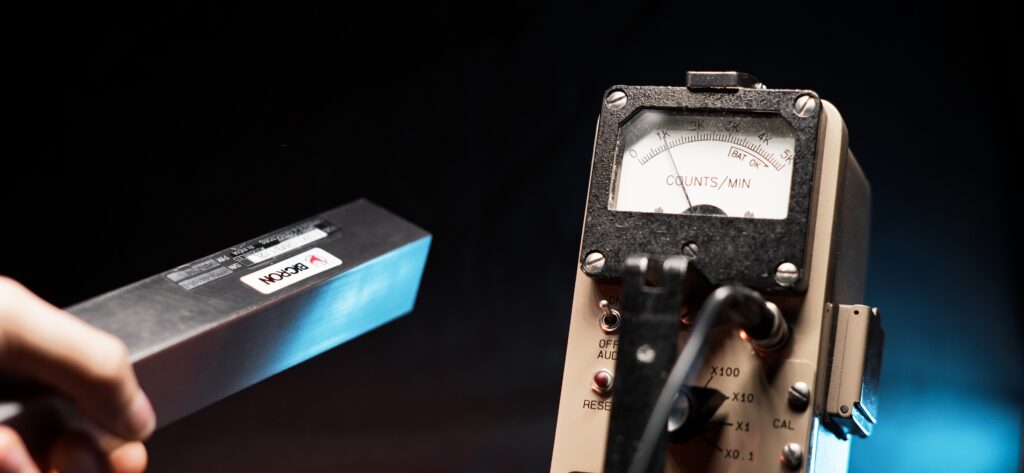
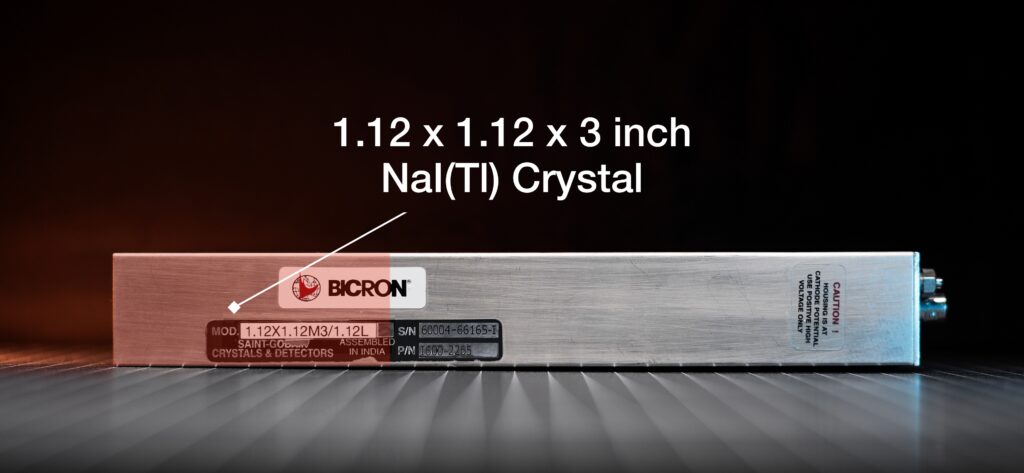
However what “counts”, is what is inside and that is a 1.12×1.12×3 inch, NaI(Tl) crystal making the probe very sensitive to gamma radiation resulting in background alone being at around 5-10k CPM. The operating voltage should be between 600V and 1000V and personally I’ve been running the scintillator at 650V without any problems and recently started to use it at 900V so that I can quickly swap out between the scintillator and my 44-9 pancake probe and I haven’t had any issues.
The extra sensitivity of the detector came in handy during my recent trip to the military aviation museum in Berlin, where I could easily pick up Radium dials in the airplanes from even a few meters away.
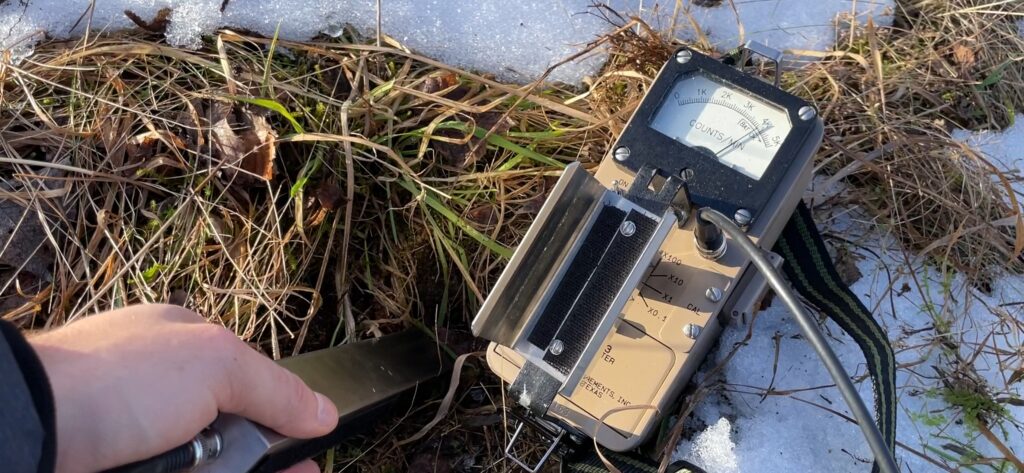
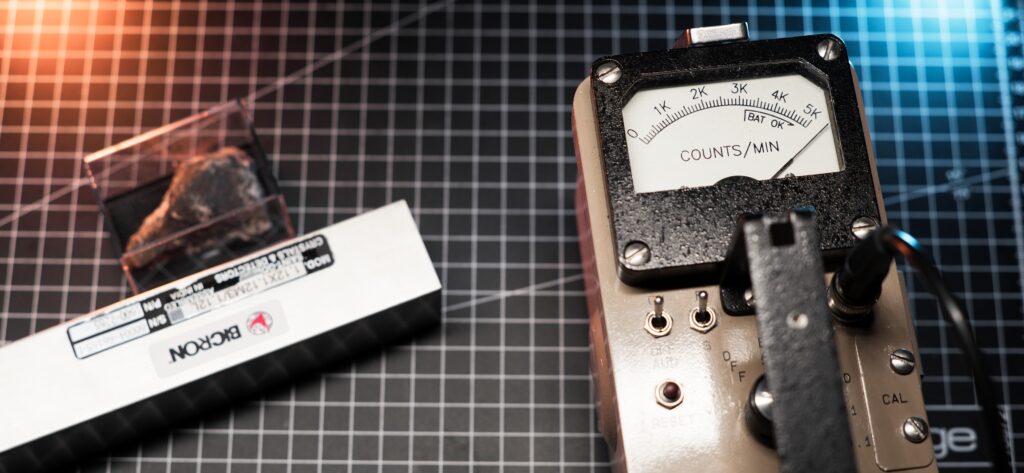
I’ve also took it on my recent Uranium prospecting trip and it performed fantastically being able to detect rocks buried deep underground, which I wouldn’t be able to find with a traditional geiger counter.
One downside of this detector is that it might be sometimes too sensitive. As mentioned before, the background alone is between 5-10k CPM, which makes only the x10 and x100 scale usable on my Ludlum Model 3 and hot rocks like the ones I found during my trip, will quickly max out my meter. So while the detector did a great job at finding hot spots, I did end up using my RAYSID and BetterGeiger S-2 and S-2L for pin pointing the exact location of the rocks. One solution could be to run the scintillator at lower voltage, maybe around 500-550V which will lower its sensitivity and give a bit more headroom.
One interesting thing about many Bicron scintillators is that they have this weird potentiometer sticking out. It is basically a gain adjustment which allows to control how strong the output is. This doesn’t affect sensitivity but can be useful for gamma spectroscopy and slightly improve resolution.

Gamma Spectroscopy and resolution
Speaking of which, this scintillator is definitely a great tool for detecting radiation, but can it be used for gamma spectroscopy? So far I had chance to test 3 of those units with my Gamma Spectacular GS-PRO-V5 and the results varied drastically from being “ok” at 7.8%, to pretty much unusable at over 13% at 662 keV. It really is a gamble with those detectors and if spectroscopy is a priority for you, then I’d definitely recommend getting a higher-end probe for that purpose.
Summary
Overall the Bicron 1.12X1.12M3/1.12L detector is a real bargain and is definitely worth considering if you’re looking for decent scintillator that wont break the bank. It won’t produce amazing gamma spectra but for radiation detection, it performs fantastically!
I want to hear from you, do you have any scintillator probes in your collection? What do you use them for? Let me know, in the comments below!
Thank you so much for reading this post, I hope you enjoyed it and learned something new! If yes, please make sure to subscribe to the email list so that you get notified when new posts are added. Also feel free to check out my Ko-Fi page where you can donate a nice cup of radioactive coffee and support my work financially.
and remember, stay active!


6 Comments
John F Van der Pol · 9 March 2025 at 03:48
thanks, real good information.
julian e. · 1 November 2025 at 05:05
Since I am looking at this unit with the bnc connector, I was wondering how you wired the bnc connector to your ludlum 3. I can follow instructions and solder, etc., but i’m no electronic wiz.
allRadioactive · 6 November 2025 at 19:26
It’s pretty straight forward. The cable has two wires, ground and hot. Hot goes into the centre pin in the BNC connector and ground goes to the enclosure. Just make sure to seal everything from light pollution as it will damage the PMT.
julian entsminger · 6 November 2025 at 21:26
Thank you for the help-sounds silly, but asking someone who has done it prevents silly mistakes with bad results.
Julian Entsminger · 20 December 2025 at 21:29
Just got one of these-it has the thin wire for a FFA 0 connector. As a noob, I thought I would ask you if I can I just slap a BNC connector on the end of that wire??
Julian Entsminger · 31 December 2025 at 02:28
Just a follow up-went ahead and cut ffa plug off and added bnc plug. worked fine! also fiddled a bit and got it to play nice with minimal chatter and reasonable response on x1 and x10 scales of my ludlum 2 by adjusting high voltage to 350-400v.