Bicron 1.12×1.12M3/1.12L Scintillator – How good is this budget scintillator

Welcome back my fellow radiation nerds, Today we will take a closer look at a budget Bicron scintillator probe and whether it is any good.

What’s the deal with this detector?

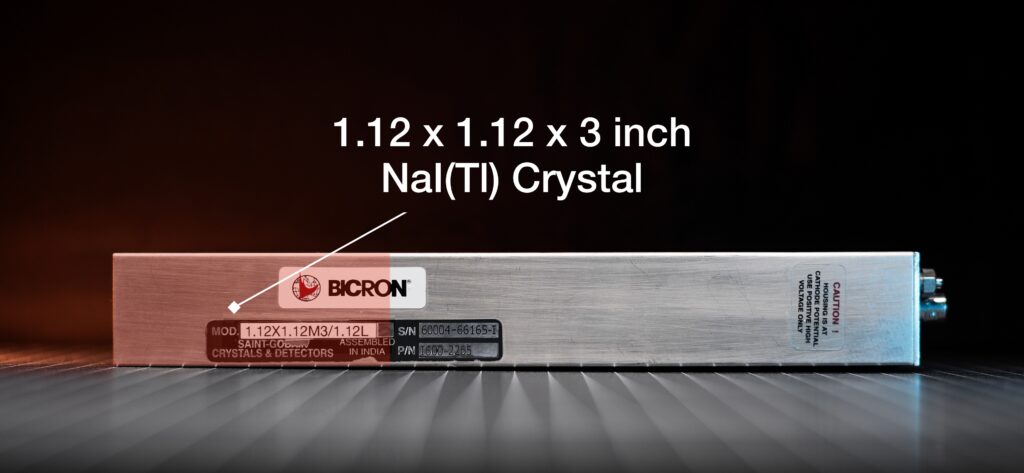
The detector we will be covering today is the Bicron 1.12×1.12M3/1.12L (P/N I600-2265). What really caught my attention, is that those scintillators can be found for dirt cheap, often way below 100 euros making them one of the most affordable scintillation probes on the market.

Originally they have been designed for use in portal monitors, which is why these detectors have a quirky, cubic design, and the cable awkwardly sticks out to the side. Since I wasn’t a fan of that, I modified my unit by adding a BNC connector at the back. It was a pretty simple mod, and if you decide to do it for yourself, be sure to properly seal back the detector to prevent any light leaks, as they will permanently damage the photomultiplier tube resulting in the failure of the detector.
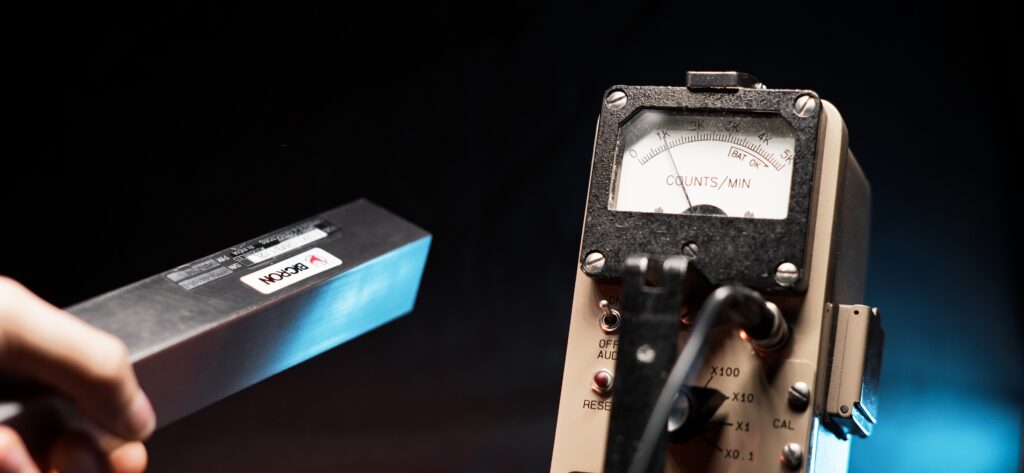
However what “counts”, is what is inside and that is a 1.12×1.12×3 inch, NaI(Tl) crystal making the probe very sensitive to gamma radiation resulting in background alone being at around 5-10k CPM. The operating voltage should be between 600V and 1000V and personally I’ve been running the scintillator at 650V without any problems and recently started to use it at 900V so that I can quickly swap out between the scintillator and my 44-9 pancake probe and I haven’t had any issues.
The extra sensitivity of the detector came in handy during my recent trip to the military aviation museum in Berlin, where I could easily pick up Radium dials in the airplanes from even a few meters away.

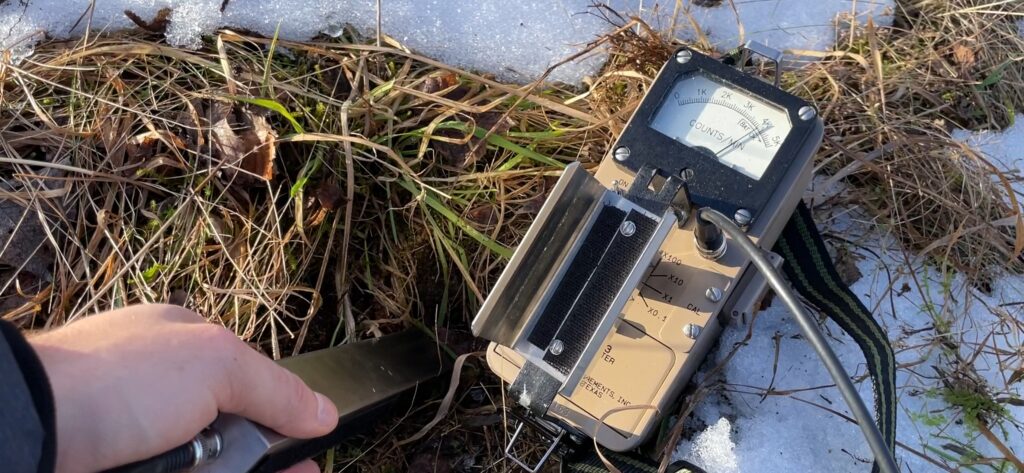
I’ve also took it on my recent Uranium prospecting trip and it performed fantastically being able to detect rocks buried deep underground, which I wouldn’t be able to find with a traditional geiger counter.

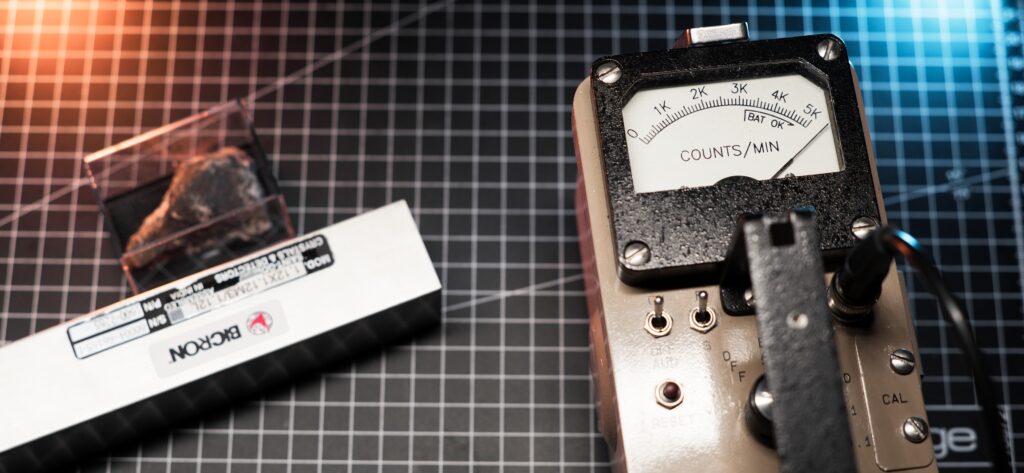
One downside of this detector is that it might be sometimes too sensitive. As mentioned before, the background alone is between 5-10k CPM, which makes only the x10 and x100 scale usable on my Ludlum Model 3 and hot rocks like the ones I found during my trip, will quickly max out my meter. So while the detector did a great job at finding hot spots, I did end up using my RAYSID and BetterGeiger S-2 and S-2L for pin pointing the exact location of the rocks. One solution could be to run the scintillator at lower voltage, maybe around 500-550V which will lower its sensitivity and give a bit more headroom.
One interesting thing about many Bicron scintillators is that they have this weird potentiometer sticking out. It is basically a gain adjustment which allows to control how strong the output is. This doesn’t affect sensitivity but can be useful for gamma spectroscopy and slightly improve resolution.

Gamma Spectroscopy and resolution

Speaking of which, this scintillator is definitely a great tool for detecting radiation, but can it be used for gamma spectroscopy? So far I had chance to test 3 of those units with my Gamma Spectacular GS-PRO-V5 and the results varied drastically from being “ok” at 7.8%, to pretty much unusable at over 13% at 662 keV. It really is a gamble with those detectors and if spectroscopy is a priority for you, then I’d definitely recommend getting a higher-end probe for that purpose.

Summary

Overall the Bicron 1.12X1.12M3/1.12L detector is a real bargain and is definitely worth considering if you’re looking for decent scintillator that wont break the bank. It won’t produce amazing gamma spectra but for radiation detection, it performs fantastically!

I want to hear from you, do you have any scintillator probes in your collection? What do you use them for? Let me know, in the comments below!


Thank you so much for reading this post, I hope you enjoyed it and learned something new! If yes, please make sure to subscribe to the email list so that you get notified when new posts are added. Also feel free to check out my Ko-Fi page where you can donate a nice cup of radioactive coffee and support my work financially.

and remember, stay active!

Adrianov’s Compass – Another Radioactive Artefact of the Cold War

Adrianov’s Compass – Another Radioactive Artefact of the Cold War

Welcome back my fellow radiation nerds. Today we will take a look at another soviet, radioactive artefact from the Cold War, the Adrianov’s Compass!

The history of the compass

The Adrianov’s compass was designed by Vladimir Adrianov in 1907 for the Russian Imperial Army and since then, it served in various countries within the Warsaw Pact until it was eventually phased out in the late 1950s. Although originally intended for military use, the compass became widely adopted by scout groups and other paramilitary organisations.

These compasses used radium paint on the tips of the arrows and few other spots to make them glow in the dark, which also resulted in them being radioactive. Due to their old age, there is no visible glow left and under black light there is a little bit of green fluorescence but the radioactivity is easily detectable..

It is worth mentioning that only the models with metal bodies and orange paint on the arrows used radium. The ones with plastic, white bodies or without orange paint aren’t radioactive.

The built quality of the compass is very solid and there are no loose parts, which definitely helps with containing any bits of radium paints that might have fallen off. This being said, there is a little bit of radon gas leaking out.

On the back there is a logo of the factory in which the compass was manufactured and the year of production. Mine was made in 1956 by SZMO (Śląskie Zakłady Mechaniczno-Optyczne w Katowicach) in Katowice, Poland. Although it is 69 years old, it is still in a great visual condition.

Today these compasses can be easily found pretty cheaply at flea markets, especially in countries that were part of the Warsaw Pact.

Activity and gamma spectroscopy of the compass

When measured with My Ludlum Model 3 with a 44-9 probe, I got a reading of 10k CPM at 1cm distance. The thick glass blocks pretty much all alpha and beta radiation and if removed, the activity from the radium paint will easily max out my meter at over 500k CPM but I strongly advise against opening any items containing radium paint.

The gamma dose from the compass is approximately 5.50 uSv/h when measured with my RAYSID at 1cm distance.

A quick gamma spectroscopy showed clear peaks for Ra-226 and its decay chain.

A few last words

Through out the history, various militaries used countless radioactive items from radium painted watches, airplane gauges to even helmet markers and while those items are definitely great collectables for anyone fascinated with military equipment of the 20th century, it is important to remember to always handle such items with most care, as Radium is a particularly nasty element, and the paint can easily fall apart and contaminate anything it touches. Remember that safety always comes first.

I want to hear from you! Do you have any radioactive watches or compasses? What other radioactive items should I explore? Let me know in the comments below!


Thank you so much for reading this post, I hope you enjoyed it and learned something new! If yes, please make sure to subscribe to the email list so that you get notified when new posts are added. Also feel free to check out my Ko-Fi page where you can donate a nice cup of radioactive coffee and support my work financially.

and remember, stay active!

The Truth About Quantum Science Items

Welcome back my fellow radiation nerds. Today we will explore the radioactivity and the nonsense of some more quantum science, scalar energy quackery items sold on Amazon!

If you enjoy this content make sure to subscribe to my channel so you don’t miss any of the upcoming uploads. Thanks and now back to the video.

In the past I explored the radioactivity of two “Quantum Energy” pendants. In both cases they have turned out to be radioactive due to the Thorium content. Since then, most of those listings have been removed but occasionally they do pop up every now and then on websites such as Amazon.

Recently I was browsing through the internet and I found some “quantum energy”, stickers which I haven’t really explored before, so I decided to order them, and see if they will be radioactive.

Sticker Nr.1

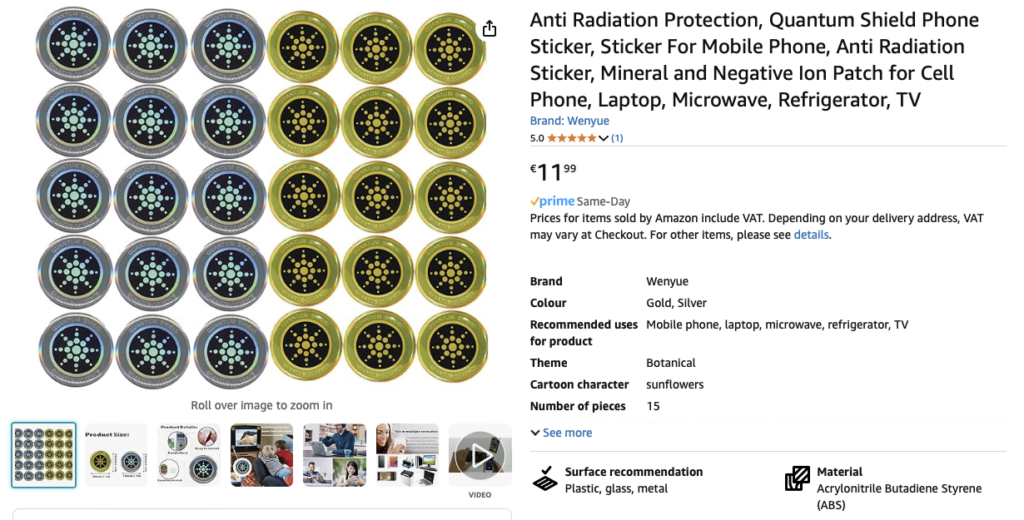
The first sticker was marketed as an anti radiation sticker that will protect the user from the “harmful” 5G radiation… Right. The definitely not photoshopped stock photos on the listing, recommend placing the stickers on all electrical devices such as phones, tablets, laptops and TVs…

Despite the stickers being marketed as anti radiation, I measured pretty decent radioactivity coming off of them. When measured from the front, I got a result of 250 CPM and 700 CPM when measured from the back of the sticker at 1cm distance, with my Ludlum Model 3 with a 44-9 probe. Im guessing that the silicon layer blocks some of the alpha and beta radiation resulting in lower activity from the front.

I was curious about how was the sticker constructed and which part in particular made it radioactive, so I used my trusty Swiss knife to peal its layers one by one and conducted a little autopsy of it.

The sticker is made of three parts, silicon top, shiny middle part and sticky brown layer at the bottom. After measuring each part separately I found that the brown bottom layer was the radioactive one.

Sticker Nr.2

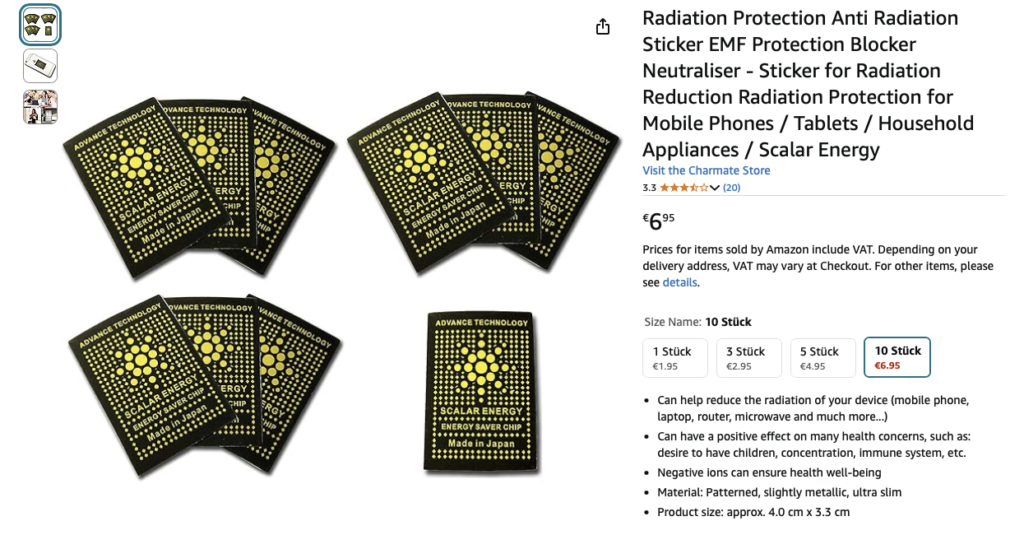
The second sticker was marketed as advance technology, Scalar Energy, Energy Saver, Made in Japan anti radiation protection…

and surprise surprise, when measured with my Ludlum Model 3 with 44-9 probe, I got a reading of over 2000 CPM at 1 cm distance.

Gamma spectroscopy and analysis of radioactive isotopes inside the stickers

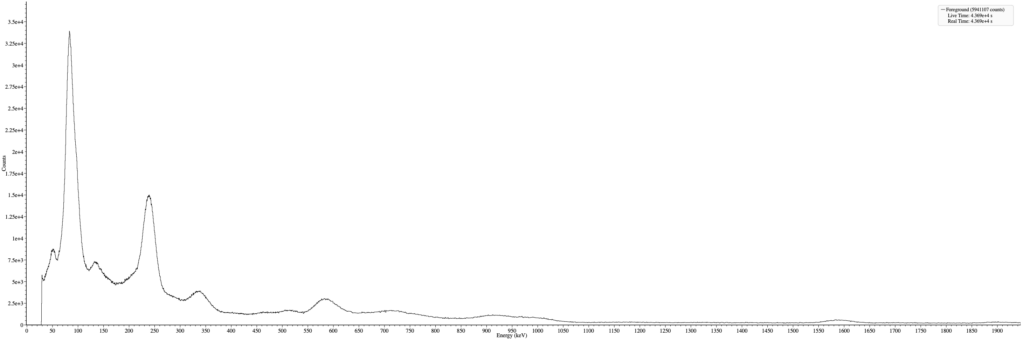
The two pendants I explored before contain radioactive Thorium 232 and I was curious if that will also be the case with these stickers. To find out, I conducted a gamma spectroscopy with my RAYSID gamma spectrometer which revealed that both of the stickers contained radioactive Thorium 232 and its decay products.

Thorium ore (Monazite) is pretty common in China, in fact it’s much more common there than uranium which is why China is currently investing heavily into Thorium breeder reactors. I’m assuming Thorium is a waste product of Monazite processing as Monazite is rich in several other rare earth elements but I have absolutely no idea why is it being added to those stickers… I guess it at least makes a pretty cool check source for all of us nuclear nerds?

While those stickers are a pretty cool and relatively safe source to handle, their marketing is very misleading and they should definitely not be sold on Amazon or similar websites under their current description. Just remember that, some people still believe in tin foil hats…


Thank you so much for reading this post, I hope you enjoyed it and learned something new! If yes, please make sure to subscribe to the email list so that you get notified when new posts are added. Also feel free to check out my Ko-Fi page where you can donate a nice cup of radioactive coffee and support my work financially.

and remember, stay active!
Terbium 161 and its radioactivity!

Welcome back fellow radiation nerds, today we will learn about the radioactivity of Terbium 161!

Element Terbium

Terbium (Tb) is a rare earth element with an atomic number of 65. It has only one naturally occurring isotope, Tb-159 and it is stable. It has been discovered in 1843 by a Swedish chemist, Carl Gustav Mosander who also the chemist behind the discovery of Lanthanum, which radioactivity and uses, I already covered in an earlier video. Since Terbium is part of the Lanthanide series, it shares many of their chemical and physical properties.

Terbium 161 and its radioactivity

Terbium 161 is a short lived radioactive isotope of Terbium and it is produced by the irradiation of stable Gadolinium 160 in the PRISMAP network of research nuclear reactors which include Maria at NCBJ (Poland), RHF at ILL (France), BR2 at SCK CEN (Belgium) and SINQ spallation neutron source at PSI (Switzerland).

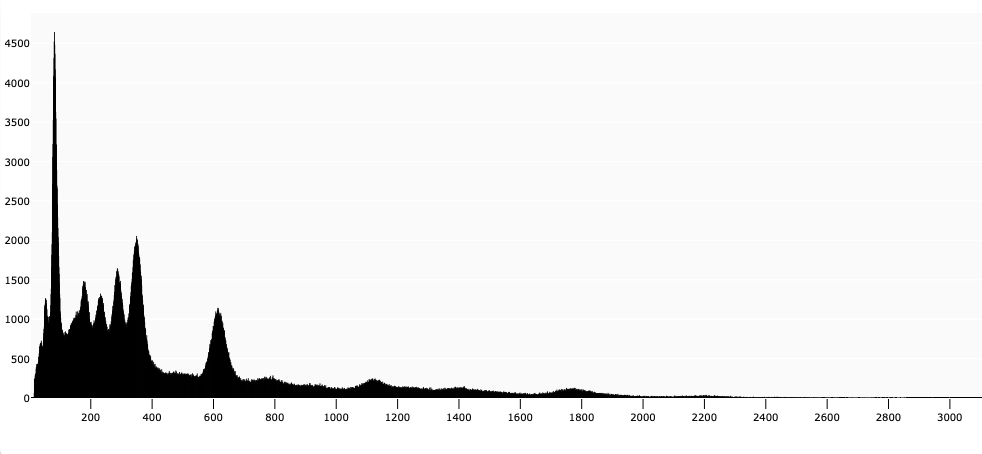
Terbium 161 gamma spectrum, RAYSID Gamma Spectrometer (FWHM <7%)

It has a half-life of just under 7 days and it decays through a beta emission into stable Dysprosium 161 and in the process it also releases a gamma ray at 25.7, 48.9 and 74.6 keV which my RAYSID had no problem in detecting.

My sample of Terbium is in a form of TbCl3 solution and it has activity of around 100-150 Bq. On my RAYSID Gamma Spectrometer I got only 16 CPS when measured inside of my lead castle, with the sample placed as close as possible to the detector. The soft beta radiation coming from the Terbium 161 is being shielded by the plastic container and I only got marginally higher activity compared to background with my Ludlum Model 3 Meter with 44-9 probe at 1cm distance.

Uses

Terbium 161 is currently being tested for use in nuclear medicine to treat prostate cancer and in imaging techniques such as SPECT (Single Photon Emission Computed Tomography).

Summary

While I don’t have much time left with this sample before it decays, it was a great fun measuring its radioactivity and learning about it. I’m curious to hear your thoughts on Terbium 161 and what did you find most interesting about it, let me know in the comments below!


Thank you so much for reading this post, I hope you enjoyed it and learned something new! If yes, please make sure to subscribe to the email list so that you get notified when new posts are added. Also feel free to check out my Ko-Fi page where you can donate a nice cup of radioactive coffee and support my work financially.

and remember, stay active!
Radioactive Metro Station in Berlin

When I first moved to Berlin, someone told me that there is a radioactive metro station somewhere in the city. Since then, I was on a mission to find it but unfortunately, with little to no success… until recently.

One of the most iconic places in Berlin must be the Brandenburger Tor and only one station away from it is the Potsdamer Platz which is home to the Sony Center as well as The Mall of Berlin, but today, we are going to focus what lies underneath the ground.

A few days ago I was coming back home from work and I had to change trains at the Potsdamer Platz S-Bahn station and as I was waiting for my train, a characteristic orange colour of the tiles caught my eye. From my bag I quickly took out my trusty Terra-P Geiger counter and I brought it near the tiles and within seconds the alarm started screaming.

Interestingly, after measuring a bunch of the orange tiles, I noticed that not all of the them where radioactive. This is most probably because some of those tiles have been replaced with newer ones which do not contain radioactive elements.

A quick gamma spectroscopy of the tiles made with my RAYSID gamma spectrometer, confirmed the presence of uranium. The peak at 186 keV indicates that these tiles contain Uranium-235 which means they were produced using natural uranium and not depleted.

Although these tiles make my Geiger counter scream, they are in fact harmless. That is because they emit mainly alpha and beta radiation and standing just a half meter away from them will result in radiation dropping to normal background levels.

So next time you are going to be visiting Berlin, make sure to bring a Geiger counter with you and check out the Potsdamer Platz S-Bahn station!

10th anniversary of the Fukushima Daiichi disaster

Exactly 10 years ago, a 9.2 magnitude earthquake hit Japan marking the beginning of one of the biggest nuclear disaster in history.

The earthquake caused the Fukushima Daiichi nuclear plant to switch to backup generators to run its cooling system. After about 50 minutes from the initial earthquake, a massive, 14-meter tall tsunami hit Japan’s coast damaging backup diesel generators at the FDNP. In the following days, hydrogen build-up in units 1, 3 and 4 caused them to exploded spreading radioactive fallout around the surrounding area and Pacific ocean.

Today, 10 years after the accident, the exclusion zone around Fukushima remains one of the most radioactive places on our planet and just like in Chernobyl, no-one knows how to deal with it…