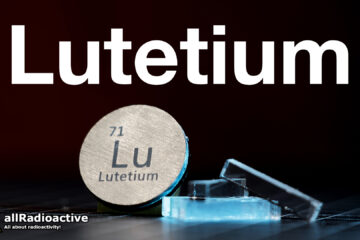
Exploring the Fascinating Radioactivity of Lutetium-176 (and Lutetium-177)

Exploring Naturally Radioactive Elements – Lutetium 176

Welcome back my fellow radiation nerds!

When we think of naturally occurring radioactive elements we mainly think of Uranium and Thorium and maybe sometimes Potassium. While those elements are the most common ones, there are many others that also have naturally radioactive isotopes. However, most of them have very long half-lives making them extremely hard to detect, especially without specialised equipment, but there are a few that can be measured with a sensitive Geiger Counter or Scintillation detector. One of them is Lutetium with its radioactive isotope of Lutetium 176.

If you enjoy this content make sure to subscribe to the channel so you don’t miss any of the upcoming uploads. Thanks and now back to the video!

The Discovery

Lutetium has been discovered independently by three scientists in the year 1907, a French scientist George Urbain, Austrian mineralogist Carl Auer von Welsbach, which you might also know as the inventor of Thoriated gas mantles, and American chemist Charles James. After years of dispute, George Urbain has been named by the scientific community as the discoverer of the new element and he named it Lutetium after Lutetia, the ancient Roman name for the city of Paris.

George Urbain
Carl Auer von Welsbach
Charles James

Properties of Lutetium

Lutetium is a rare earth element with an atomic number of 71. It is the last element in the Lanthanide series and it shares many of the chemical properties with other elements in the group. In nature, it has only 2 isotopes, a stable Lutetium 175 (97.4%) and a radioactive Lutetium 176 (2.60%).

Lutetium 176 undergoes a beta decay with an average energy of 182 keV, turning into Hafnium 176 with a half-life of 37.8 Billion (3.78e10) years, and in the process it also emits gamma rays at 88, 202 and 307 keV. What is Interesting about Lutetium 176 is that the both gamma rays of 202 and 307 keV are emitted in coincidence with each other, forming summing peak at 509keV

RAYSID Gamma Spectrometer (<7% at 662keV resolution)

Uses of Lutetium

Today Lutetium doesn’t see much use due to its difficult production and very high costs but it can be found in some specialised fields. One of its main uses is in the production of scintillation crystals which are used in positron emission tomography (PET) scans.

It can also be found in some alloys like in the case of like LuAG where it improves the overall durability and heat resistance of the material.

And thanks to its long half-life, Lutetium 176 can be used for Lutetium-hafnium dating of meteorites.

My samples & their radioactivity

At the moment, I have two types of Lutetium samples. The first one is a form of LYSO scintillation crystals which I got from a friend of mine (thanks James!), I have linked his eBay store in the description below in case you want to grab one for yourself.

James Ebay Store

When measured with SE International Ranger which uses a LND7317 Pancake type tube, I got from a single crystal 73 CPM, only 30 CPM over the background radiation. When measured with my RAYSID I got an increase of 15 CPS in the activity which is more than enough to build a gamma spectrum, however a good lead castle to minimise background radiation is definitely a good idea.

As mentioned before, these crystals are used in positron emission tomography (PET) and when exposed to radiation they glow in a light blue colour.

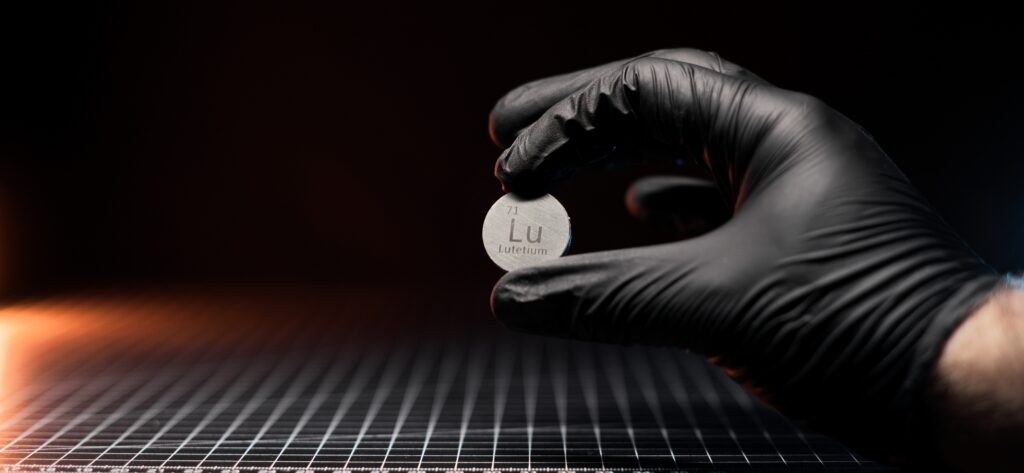
My second sample is a metal coin made out of pure Lutetium metal which measures 24.26 mm x 1.75 mm and weighs about 8.43g, this means it contains around 0.218g of pure Lu176 that has activity of approximately ~432 Bq. Compared to the LYSO crystal, the activity is a bit higher and reads on my Ranger 160 CPM above background and 55 CPS on my RAYSID.

Since the coin is made of pure metal, it is much denser than the LYSO crystal and some of the activity gets self shielded which results in the readings being a big lower than expected.

Since I use it as my main Lu-176 source for gamma spectroscopy, I decided to put it in a 1″ plastic disk with a label stylised a bit after other professional calibration sources. While it might be a bit goofy or silly to some, I do enjoy a consistent look of my sources and I’m very happy with the results.
Isotope Lutetium 177

In nuclear medicine, a synthetic isotope of Lutetium, Lu-177 is used in targeted cancer therapy. It is produced by neutron irradiation of Lu176 and it decays through a beta emission into Hafnium 177 with a half-life of 6.65 days and it emits two gamma rays at 113 keV and 208 keV.

A good friend of mine works in a nuclear lab and recently they received a fresh batch of Lu177 for their experiments and he was kind enough to make some videos showcasing the samples, testing them against some of his meters and take a gamma spectrum of them. Big Thanks for the help!

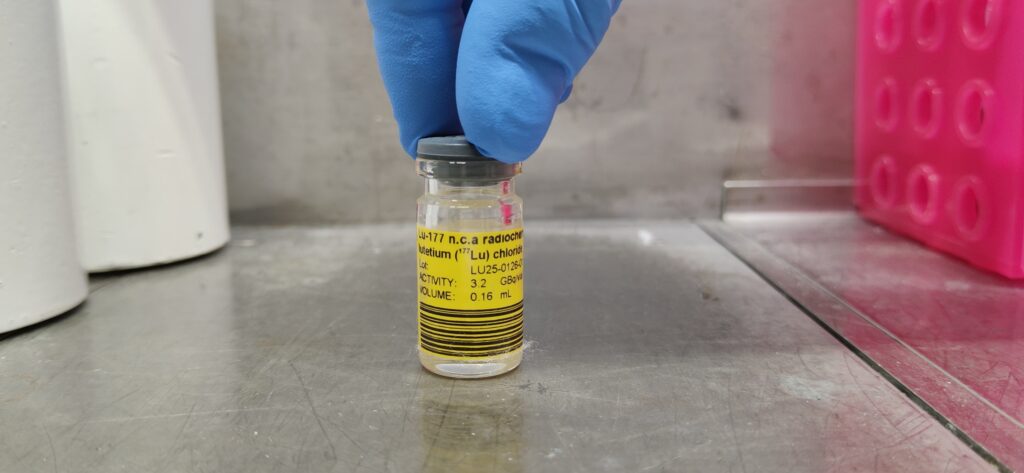
Originally this vial contained 3.2GBq of Lu-177 in form of Lutetium Chloride solution, however most of it has been already removed and now there are only traces of Lu-177 left. Despite that, the vial still read pretty high on the RadEye B20 with over 60k CPM and registered 760uSv/h on the RAYSID.
Summary

Exploring the radioactivity and the history of Lutetium and its isotopes was definitely a great experience and I have learned a lot about it. I want to hear from you, did you know about the natural radioactivity of Lutetium and do you have any samples of it? What other radioactive elements should I cover next? Let me know in the comments below!


Thank you so much for reading this post, I hope you enjoyed it and learned something new! If yes, please make sure to subscribe to the email list so that you get notified when new posts are added. Also feel free to check out my Patron page where you can support the channel financially and get some additional exclusive content.

and remember, stay active!

Lead 210 – Why Radon is actually not so short lived

Welcome back my fellow radiation nerds! Today we will take a closer look at a radioactive isotope of lead, Lead 210!

Element Lead 208

The element Lead (Pb) is a dense, heavy metal with an atomic number of 82, making it the heaviest stable element in the periodic table. Despite its high density, Lead is surprisingly soft, which makes it easy to bend and shape. In its pure form, Lead has a silvery grey colour, similar to most metals but if it is exposed to air, it will oxidise and darken over time as a layer of lead oxide forms on its surface.

Lead has been known to humanity since the ancient times where it was a popular material thanks to its malleability and relatively low melting point of 327 °C. For example the Romans, used Lead in plumbing, cookware, and cosmetics. However, they weren’t aware of its toxicity which contributed to many health issues including neurological damage, gastrointestinal problems, and developmental delays.

Today the use of lead is much more limited to help minimise potential health risks it poses but it is still being used in some key industries including production of lead acid battles or in radiation shielding.

In nature, there are several isotopes of lead, with the most common being Lead 208, which makes up 52.4%. This is followed by Lead 206 at 24.1% and Lead 207 at 22.1%. All of these isotopes are stable, but lead also has a few naturally occurring radioactive isotopes. These isotopes, are found in the decay chains of Uranium or Thorium, and aren’t present in typical lead ore. Most of them have a pretty short half-lives ranging from a few minutes to several hours—except one: Lead 210.

Radioactive Lead 210

Lead 210 exists naturally in trace amounts as it is one of the daughter isotopes of Uranium, more precisely it is produced by the decay Polonium 214 through an alpha emission or by the beta decay of Thallium 210. It undergoes a beta decay into Bismuth 210 and it also releases a gamma ray at 47 keV and has a half-life of 22.3 years. Bismuth then undergoes a beta decays into Polonium 210 which finally decays into a stable Lead 206 by releasing an alpha particle.

Very rarely Lead 210 will undergo an alpha decay turning into Mercury 206 which then decays through a beta emission into Thallium 206 which finally decays by releasing a beta particle, turning into a stable Lead 206

Since lead 210 is the only Radon daughter isotope with long half-life, it can accumulate and build up over time in areas where high levels of radon gas are present. This is the case with my DP-63-A, which insides are still heavily contaminated with Pb-210 despite the Radium dial being removed long time ago.

My sample

My sample of Lead 210 is a bit of an unconventional one. In order to create it, I used active carbon pallets which I then exposed to a strong radon emitter and I left them sealed in a jar for over two years. After removing the radon source, the jar was highly radioactive due to all the short lived isotopes being present but after a few day, they have decayed leaving only longer lived isotopes including Lead 210 and Polonium 210 inside.

When the lid of the jar is removed, the active carbon pellets reads 500 CPM on my Ludlum Model 3 with a 44-9 probe when measured just above the opened jar. The gamma dose rate is just barely above background and my RAYSID only detects an increase of about 10 CPS when placed right next to the jar.

Gamma spectroscopy

A gamma spectroscopy of my Lead 210 revealed a clear peak at 47keV with a smaller X-ray peak to the left. This peak at 47keV can be also seen in gamma spectra of Uranium or Radium samples which makes it pretty interesting to see how peaks from parent isotopes star to disappear as we go lower in the decay chain.

Gamma spectra made with RAYSID <7% FWHM

Summary

Exploring the radioactivity of Lead 210 was a lot of fun and I certainly learned a lot about it! It definitely showed me that while radon might have a short half-life of only 3.6 days, its daughters will remain radioactive for many years to come.

If you want to find out more about Radon I recommend checking out my previous video on it, which I have linked in the description.

I want ot hear from you! Do you have any Lead 210 samples and what other radioactive isotopes should I cover in the future videos? Let me know in the comments below!


Thank you so much for reading this post, I hope you enjoyed it and learned something new! If yes, please make sure to subscribe to the email list so that you get notified when new posts are added. Also feel free to check out my Ko-Fi page where you can donate a nice cup of radioactive coffee and support my work financially.

and remember, stay active!

What people forget when collecting uranium minerals…

Welcome back my fellow radiation nerds. Today we will explore a the radioactivity of a noble gas that is the second leading cause of lung cancer, Radon 222!

During my recent trip to US, I visited a couple of famous uranium mining sites including Mi Vida and Cotter mines. There I collected a few small samples of the uranium minerals and while the radiation coming from those samples might be a bit high when measured up close, it is important to remember that they are point sources and with distance, the activity drops quickly back to normal levels. Furthermore, the plastic display boxes I keep the samples in, prevent the spread of any particles and pieces that might have fallen off the main mineral.

However what concerns me is not the radiation coming from the Uranium minerals, but a gas emitted by them called Radon.

So what’s the deal with radon?

Radon 222 is a naturally occurring radioactive element with an atomic number of 86 and it is a part of the uranium decay chain, directly being produced by the decay of Radium 226. It was first identified in 1899 by Ernest Rutherford and Robert B. Owens at the McGill University in Montreal, making it the fifth radioactive element to ever be discovered. It has a half-life of 3.8 days and it decays into Polonium 218 through alpha emission with an activity of 5.67 × 10¹⁵ Bq/g (5.67 PBq or 153 Curies).

What makes Radon particularly dangerous, is its possible buildup in side of buildings as it escapes from ground as a result of natural uranium decay. Its detection is challenging as Radon is a noble gas and it doesn’t have any smell, taste or colour and can only be detected using specialised equipment. This results in Radon gas being the second leading cause of lung cancer, second only to smoking cigarets.

Furthermore, Radon decay products can easily attach themselves to anything they come in contact with, this includes cloths, hair and also lungs if inhaled. While the half-life of radon is only 3.8 days, it decays into toxic, heavy metals including Polonium, Thallium and Lead. This means that if inhaled, these elements will remain in the lungs and eventually be absorbed by the body.

In some countries, Radon tests are mandatory for residential and public buildings and the levels should not exceed 300bq/m3, although WHO recommends to keep the levels below 100Bq/m3 and EPA recommends action if radon levels exceed 148 Bq/m³ (about 14 pCi/L).

If you have ventilation system with air filters inside your building, you can do a simple experiment and check the filters for Radon using a simple geiger counter. I did that at my parent’s place and their filters clearly showed increase levels of radiation. This is perfectly normal and should not be anything to worry about as long the Radon levels inside the house are within the recommended limits.

A gamma spectroscopy of an active carbon sample that has been exposed to radon gas shows interesting spectrum. While it is similar to Uranium or Radium, it clearly misses peaks from isotopes found higher in the decay chain

Here is a gamma spectrum of uranium ore for comparison. As you can see, the peaks from U-235 and Ra-226 are missing

Isn’t my geiger counter good enough?

Now you may wonder, I have a geiger counter, can’t I use it to measure radon? Well, technically yes, but it’s a bit more complicated than that. While a Geiger counter can detect radiation from radon decay products, it is not an ideal tool for the detection of radon gas or measuring its concentration. In order to do that a dedicated radon meter must be used which is specifically designed for this purpose and will give precise, long-term measurements, which are essential for evaluating any potential health risks from radon exposure.

Aranet Radon Plus & Aranet Radiation Meters

In order to keep track of the radon levels at my home, I reached out to the amazing guys over at Aranet who have kindly provided me with their Radon Plus & Radiation meters which inspired and made this video possible.

The meters look great and have very nice, elegant design and use a E-Ink displays, which looks fantastic and consumes very little energy allowing them to run for multiple years on just two AA batteries which come included in the box. The initial setup and connecting the meters to the Aranet phone app was a piece of cake and the app allows to get much more insight about the data being recorded.

Both meter are fairly compact and have the same width and hight, however they do differ in their depth as the Radon Plus uses ionisation chamber which requires extra room compared to pin diode detector used by background radiation meter.

Aranet Radon Meter can switch between different averaging periods from 10 min, 24h, 7d, 30d. Radon levels do fluctuate depending on the weather, temperature and other environmental factors and this allows for obtaining precise and accurate readings over time.

If you want to learn more about those meters, make sure to either check out Aranet website (click here) or their YouTube channel.

My Radon Levels

Coming back to my concern about the radon levels. After setting up both meters, I allowed them to run for a few day so that they could collect an average measurement. When I checked the Aranet app, I saw that the readings for Radon concentration were around 40Bq/m3 depending on the time of the day and the background radiation hovered at around 0.10uSv/h, which is more than acceptable and within the recommended limits.

Realistically, having just a few small uranium minerals should not cause any significant increase in radon levels but I’ll continue to monitor the readings just in case, especially since winter is coming and ventilating my home isn’t as easy as in the summer time.

What to do if my levels are high?

Although I haven’t measured any significant levels of radon at my home, this might not be true for everyone. If the your levels are elevated, the easiest solution is ventilate the room more often. In some extreme cases, a more drastic measures have to be taken which can include sealing off the basement floor or installing an active ventilation system but I’d recommend consulting a specialist first before taking any action.

Where to get Radon and Radiation home meters

If you are a collector of uranium minerals, radium watches or other items that can produce radon gas, a Radon meter is a definitely a must. This being said, if you live in an area with known to have high levels of Radon concentration, investing in a Radon meter is definitely a good idea.

The team at Aranet has also provided me with discount code for all viewers of the channel. So if you decide to buy a meter from Aranet, make sure the enter ALLRAD5 at checkout which will give you 5% off from your order. Alternatively you can also use the links in the description of the video:

Radon meter: https://bit.ly/4dNCZdn
Radiation meter: https://bit.ly/3ZkwkTI

Thank you Aranet once again for providing me with the meters and making this video possible!

I’m curious to hear about your experiences with Radon. Do you live in high radon area, do you use a Radon meter and how do you control the levels at your home? Let me know in the comments below!


Thank you so much for reading this post, I hope you enjoyed it and learned something new! If yes, please make sure to subscribe to the email list so that you get notified when new posts are added. Also feel free to check out my Ko-Fi page where you can donate a nice cup of radioactive coffee and support my work financially.

and remember, stay active!

Terbium 161 and its radioactivity!

Welcome back fellow radiation nerds, today we will learn about the radioactivity of Terbium 161!

Element Terbium

Terbium (Tb) is a rare earth element with an atomic number of 65. It has only one naturally occurring isotope, Tb-159 and it is stable. It has been discovered in 1843 by a Swedish chemist, Carl Gustav Mosander who also the chemist behind the discovery of Lanthanum, which radioactivity and uses, I already covered in an earlier video. Since Terbium is part of the Lanthanide series, it shares many of their chemical and physical properties.

Terbium 161 and its radioactivity

Terbium 161 is a short lived radioactive isotope of Terbium and it is produced by the irradiation of stable Gadolinium 160 in the PRISMAP network of research nuclear reactors which include Maria at NCBJ (Poland), RHF at ILL (France), BR2 at SCK CEN (Belgium) and SINQ spallation neutron source at PSI (Switzerland).

Terbium 161 gamma spectrum, RAYSID Gamma Spectrometer (FWHM <7%)

It has a half-life of just under 7 days and it decays through a beta emission into stable Dysprosium 161 and in the process it also releases a gamma ray at 25.7, 48.9 and 74.6 keV which my RAYSID had no problem in detecting.

My sample of Terbium is in a form of TbCl3 solution and it has activity of around 100-150 Bq. On my RAYSID Gamma Spectrometer I got only 16 CPS when measured inside of my lead castle, with the sample placed as close as possible to the detector. The soft beta radiation coming from the Terbium 161 is being shielded by the plastic container and I only got marginally higher activity compared to background with my Ludlum Model 3 Meter with 44-9 probe at 1cm distance.

Uses

Terbium 161 is currently being tested for use in nuclear medicine to treat prostate cancer and in imaging techniques such as SPECT (Single Photon Emission Computed Tomography).

Summary

While I don’t have much time left with this sample before it decays, it was a great fun measuring its radioactivity and learning about it. I’m curious to hear your thoughts on Terbium 161 and what did you find most interesting about it, let me know in the comments below!


Thank you so much for reading this post, I hope you enjoyed it and learned something new! If yes, please make sure to subscribe to the email list so that you get notified when new posts are added. Also feel free to check out my Ko-Fi page where you can donate a nice cup of radioactive coffee and support my work financially.

and remember, stay active!

Exploring Krypton 85 and its radioactivity

Welcome back fellow radiation nerds, today we dive deep into the radioactivity and uses of Krypton 85!

Krypton is a colourless, tasteless and odourless noble gas and it was first discovered in 1898 by Wiliam Ramsay and Morris Travers. It has atomic number of 36 and its most common isotope is Krypton 84, which is stable.

Kr-85 on the other hand, is radioactive and it was first discovered in 1940 by Martin Kamen and Sam Ruben, during their research involving the neutrons bombardment of stable Krypton isotopes, at the University of California, Berkeley.

Krypton-85 is predominantly produced through human activities such as nuclear fission and the reprocessing of spent nuclear fuel, however, traces of Krypton 85 are also produced naturally by the interaction of cosmic rays with a stable Krypton-84 found in Earths atmosphere.

Some of the main uses of the radioactive Krypton 85 are in arc discharge lamps and in cold-cathode voltage regulator electron tubes. Since Krypton is a gas, it can also be used to find leaks in closed systems and small defects in aircraft components.

Radioactivity & Gamma spectroscopy

Krypton-85 is a radioactive isotope with a half-life of approximately 10.76 years. It decays by beta emission, transforming into stable rubidium-85 and in the process it also releases a gamma ray with an energy of 514 keV. 

Krypton 85 gamma spectrum, RAYSID Gamma Spectrometer (FWHM <7%)

My Sample

My sample comes in the form of an old DDR smoke detector produced by Robotron RFT. The model number is 70130 and it was used in industrial complexes. The actual radioactive source is a little glass bulb originally containing 18.5MBq of Kr-85.

Robotron office (Source: DNN.de)

Since the detector is couple decades old by now, the activity of Krypton 85 decreased but it is still detectable when measured with my RAYSID gamma spectrometer. When placed on the top of the detector, RAYSID showed an activity of 136 CPS and had no problem in detecting the peak at 514 keV.

German smoke detectors and the activity of their sources (source: geigerzaehlerforum)

The housing of the smoke detector acts like a shield and stops most of the beta radiation, which results only in a slight increase in the activity when measuring it with my Ludlum Model 3 Meter with a 44-9 probe. This however changes when the housing is removed and the glass bulb is exposed. At 5cm my Ludlum reads 500 000 CPM and it maxes out if brought any closer. RAYSID reads a gamma dose of 0.86 uSv/h (675 CPS) at 1cm distance.

Rundfunk RFD 70361 smoke detector source containing <18.5 MBq of Kr85

Overall I am very happy to finally get a chance to explore the radioactivity of Krypton 85 and share my experiences. I absolutely love shape and form of the source and I find it very interesting that this smoke detector uses Kr85 instead of much more common Am241. If you ever come by one of those detectors, they are a great find but be careful as the glass bulb is rather fragile and can easily break

Thank you so much for reading this post, I hope you enjoyed it and learned something new! If yes, please make sure to subscribe to the email list so that you get notified when new posts are added. Also feel free to check out my Ko-Fi page where you can donate a nice cup of radioactive coffee and support my work financially.

and remember, stay active!

Why is Coal Radioactive?

NORM is an acronym for Naturally Occurring Radioactive Material and it covers, well, all radioactive material that occurs is nature. Some of the main elements that make up NORM are Uranium Thorium and Radium. Traces of these elements can be found pretty much everywhere but sometimes their accumulation can result in radioactive contamination of materials which are not usually thought as radioactive.

Why is coal radioactive

Not that long ago, a friend of mine send me a sample of coal which comes from an area near Dresden in Germany. This region is very rich in coal deposits but they are not pure. Coal easily absorbs elements that surround it and in this case, it was in close proximity to uranium which resulted in it getting contaminated and also becoming radioactive.

The sample measures 6cm by 4cm by 3 cm and reads about 2 500 CPM on a pancake probe at 1cm distance. A gamma spectroscopy made with my RAYSID gamma spectrometer, shows a clear presence of natural uranium and its decay products.

RAYSID Gamma Spectrometer (FWHM <7%)

While this is an extreme example, coal can contain trace amounts of radioactive elements and burning it, will results in the release of these elements into the environment. Considering how much coal is burned to produce energy each year, it is safe to say that coal power plants produce more unregulated nuclear waste than any nuclear power plant does. It is ironic how some countries build coal power plants instead of nuclear ones since they are afraid of nuclear energy and yet coal power plants are the ones producing more unregulated nuclear waste and contaminating our environment with toxic elements.

Thank you so much for reading this post, I hope you enjoyed it and learned something new! If yes, please feel free to subscribe to the email list so that you get notified when new posts are posted. Also feel free to check out my Ko-Fi page where you can donate a nice cup of radioactive coffee and support my work financially.

and remember, stay active!

Radioactive Tungsten Electrodes (TIG)

Introduction

Today I want to show you an item that you can find in a hardware store and it is radioactive. Let’s take a closer look at the thoriated Tungsten electrodes!

Main information

There are three types of thoriated Tungsten electrodes with the only difference being the amount of Thorium in them. Yellow ones contain around 1% of Thorium, red contain 2% and orange contain 4%. Even though orange ones contain the highest amount of Thorium, they are actually not much more radioactive than the red ones which are the most common. Tungsten electrodes come in different sizes with the bigger ones being slightly more active. Personally, I decided to go with 3.2mm x 175mm but smaller should also work fine.

Red Tungsten Electrodes (WT20)

Isotope: 232Th

Activity: < CPM (LND 7311)

Amount: ~2%

Since the label on the box clearly states that these electrodes contain Thorium, I didn’t expected the gamma spectroscopy to show anything intresting but to my suprise, it did!

Slide to the right to see Thorium gas mantle spectrum
Slide to the Left to see Thoriated Tungsten electrodes spectrum

The main two differences between the spectrum of Tungsten electrodes and the spectrum of Thorium gas mantle are the peak at 511 keV and the peak 583 keV. Let’s start with the peak at 511 keV. It is referred to as annihilation peak and it is caused by the annihilation of a positron by its interaction with an electron. This event can occur more often in Tungsten electrodes because of their density. The peak at 583 keV is caused by Thallium 208. When Thorium decays, it emits Radon 220 which is a gas and it escapes into the air but in the case of the Tungsten electrodes, it is trapped by dense Tungsten which results in the accumulation of Radon decay products including Thallium 208.

Thorium decay chain (source: metadata.berkeley.edu)

Safety

These electrodes are often used as a check source because of how easy to find they are and their small activity which makes them relatively safe. That being said, when used for their original purpose, the dust generated by sharpening them could cause health problems in the long run if inhaled.

Fake Tungsten Electrodes

When buying these electrodes, make sure to buy branded ones because unfortunately, unbranded ones are often fake and they do not contain Thorium. I made this mistake twice and both times I received fake electrodes that weren’t radioactive.

Radioactive BH-45M Switch

Today we will take a closer look at a radioactive, soviet switch, the BH-45M!

The production of BH-45M switches started in 1945 and continues till this day, this being said, not all of those switches are radioactive. Units produced until 1965 used radium paint but in later models, radium paint was replaced by a nonradioactive one. The very early models which were produced until early 1950s, used RaBr2 while the ones produced later used RaSO4. BH-45M switches are mainly used in military vehicles such as tanks but can also be found in some civilian ones. These switches were produced in countries of Warsaw Pact and can be found today cheaply at antique markets.

As a result of constant exposure to nuclear radiation, the paint decays and with time it loses its radioluminaces properties. Today the glow from the switch is undetectable for human eye but a photo made with a long exposure shows that there is still little bit of glow left.

Long exposure of BH-45M switch

Radium is a particularly nasty element not only because of its very high activity and radio toxicity but also because it decays into a radioactive gas called radon which in large doses can be dangerous. Luckily, the switch I have is pretty well sealed and doesn’t leak too badly, so the radon emission is relatively low.

Activity and Gamma Spectroscopy

Radium painted items range in activity anywhere from few hundred CPM to hundreds of thousands depending on the amount of radium paint used. When it comes to BH-45M switches, they are definitely are on the hotter side. The one I have measures at around 220k CPM at 1cm distance on a pancake probe and 10uSv/h gamma only at 1cm distance on my RAYSID gamma spectrometer.

Just as expected, a gamma spectroscopy of the BH-45M switch shows a very characteristic gamma spectrum for Ra226 and its decay products.

Radioactive Cesium 137

Today we will explore the radioactivity and uses of Caesium 137!

Caesium is probably best known for its high reactivity and low melting point of only 28.5°C and it was first discovered in 1860 by two German scientists, Robert Bunsen and Gustav Kirchhoff. It has atomic number of 55 and has only one natural isotope, Caesium 133 which is stable. Caesium 137 on the other hand is a radioactive and it is produced by a nuclear fission of Uranium 235 and it is commonly found in nuclear waste and fallout. It has a medium-short half-life of 30.1 years and a single gram has an activity of 3.215 TBq (86.9 Ci).

TG-36 spark gap tube containing <1 uCi of Cs-137

Uses

Since Caesium 137 is one of the main radioactive elements found in nuclear fallout, it is very often used as a calibration source for radiation detectors. It also has many applications in the medical industry where it can be used in radio-therapy to fight cancer or to sterilise medical equipment. It can also be found in thickness gauges, flow meters and in gamma-ray well logging devices. Because Caesium 137 wasn’t produce before 1945, it can be used to date wine and detect counterfeits.

Health risks

Caesium 137 is one of the most dangerous isotopes found in nuclear fallout because of its strong gamma-rays but unlike Strontium 90, if ingested it is distributed around the body more or less evenly and it has a short biological half-life of 70 days.

Caesium 137 in mushrooms collected in Belarus

Radioactive decay & gamma spectroscopy

Caesium 137 is a beta and a gamma emitter. In 94% of the cases, it emits a beta particle (511 keV) turning into a metastable Barium 137m which then emits a gamma-ray (662 keV) before becoming stable. In the remaining 6% of cases, Caesium 137 decays directly into stable Barium 137 by a beta emission (1172 keV).

Caesium 137 has a very characteristic gamma spectrum with two large peaks at 31 keV and 662 keV which make it a very popular calibration source for gamma spectrometers.

TG-36 tube, RAYSID gamma spectrometer FWHM <8.5%

My samples

As of right now, I got two samples of Cs137. The first one is a TG-36 Spark Gap Tube produced by CP Clare. According to the date code, it was produced in the September of 1985 and it originally contained <1uCi of Cs137. Today the activity drop to <0.43uCi but it is still detectable and it measures just over 1 uSv/h on my RAYSID gamma spectrometer and about and about 450 CPM on my Ludlum Model 3 with 44-9 probe at 1cm.

TubeOriginal activity
CK1097-15< 280 pCi / 10.4 Bq
EII-43-100Unknown
TG-20A< 1 uCi / 37 kBq
TG-29Unknown
TG-30<5 uCi / 185 kBq
TG-36< 1 uCi / 37 kBq
TG-53< 5 uCi / 185 kBq
TG-54<1 uCi / 37kBq
TG-77< 0.9 uCi / 33.3 kBq
TG-133< 5 uCi / 185 kBq
TG-162< 5 uCi / 185 kBq
XG-1684< 1uCi / 37 kBq
Table with some of the tubes that used Cs-137

My other source is made from ashes of Belarusian mushrooms which contain the fallout from Chernobyl. They clock at almost 250 CPM on my Ludlum at 1cm distance but when measured in a lead castle with my RAYSID, the activity increased only by 6.5 CPS.

Radioactive Cobalt 60

Cobalt 60 is a radioactive isotope of Cobalt and it is produced by neutron activation of stable Cobalt 59 in nuclear reactors. Since it has a short half-life of only 5.3 years, it does not occur in nature and all samples that exist are synthetic. A single gram of Co-60 has an activity of 44TBq and it undergoes a beta decay into an excited state of Nickel 60 which emits two gamma rays at 1173 and 1332 keV before becoming stable.

Gamma spectroscopy of Cobalt 60

One of the main uses of Cobalt 60 is in radiotherapy where cancer cells are exposed to a beam of high energy gamma radiation, effectively killing them. Its gamma rays are also used in the sterilisation of food and medical equipment and they can even be used in levelling devices and thickness gauges to detect structural errors.

Bomac 1B63A Waveguide Tube

For decades tubes have been a key component of electrical devices such as radios, amplifiers and many more. Some of these tubes contained radioactive elements which improved the ionisation process and also made them radioactive.

My sample of Co-60 is in an old Bomac 1B63A tube which was originally used in radars and it contained <1uCi of Co-60. These tubes have been manufactured in the late XX century and sadly there is no detectable activity left since almost all of Co-60 has decayed.

Dirty nukes

Unfortunately, Cobalt 60 can also be used in weapons of mass destruction. Dirty nukes or salty nukes are nuclear weapons that contain Cobalt 59 but during nuclear fission, it turns into Cobalt 60 which contaminates the surrounding area for decades. Officially, there are no countries in possession of such weapons and let’s hope that even if there are, they will never use them.

Donate

If you would like to support my work financially, feel free to buy me a nice cup of radioactive coffee.