Welcome back my fellow radiation nerds! Today we will take a closer look at a radioactive isotope of lead, Lead 210!
Element Lead 208
The element Lead (Pb) is a dense, heavy metal with an atomic number of 82, making it the heaviest stable element in the periodic table. Despite its high density, Lead is surprisingly soft, which makes it easy to bend and shape. In its pure form, Lead has a silvery grey colour, similar to most metals but if it is exposed to air, it will oxidise and darken over time as a layer of lead oxide forms on its surface.
Lead has been known to humanity since the ancient times where it was a popular material thanks to its malleability and relatively low melting point of 327 °C. For example the Romans, used Lead in plumbing, cookware, and cosmetics. However, they weren’t aware of its toxicity which contributed to many health issues including neurological damage, gastrointestinal problems, and developmental delays.
Today the use of lead is much more limited to help minimise potential health risks it poses but it is still being used in some key industries including production of lead acid battles or in radiation shielding.
In nature, there are several isotopes of lead, with the most common being Lead 208, which makes up 52.4%. This is followed by Lead 206 at 24.1% and Lead 207 at 22.1%. All of these isotopes are stable, but lead also has a few naturally occurring radioactive isotopes. These isotopes, are found in the decay chains of Uranium or Thorium, and aren’t present in typical lead ore. Most of them have a pretty short half-lives ranging from a few minutes to several hours—except one: Lead 210.

Radioactive Lead 210
Lead 210 exists naturally in trace amounts as it is one of the daughter isotopes of Uranium, more precisely it is produced by the decay Polonium 214 through an alpha emission or by the beta decay of Thallium 210. It undergoes a beta decay into Bismuth 210 and it also releases a gamma ray at 47 keV and has a half-life of 22.3 years. Bismuth then undergoes a beta decays into Polonium 210 which finally decays into a stable Lead 206 by releasing an alpha particle.
Very rarely Lead 210 will undergo an alpha decay turning into Mercury 206 which then decays through a beta emission into Thallium 206 which finally decays by releasing a beta particle, turning into a stable Lead 206
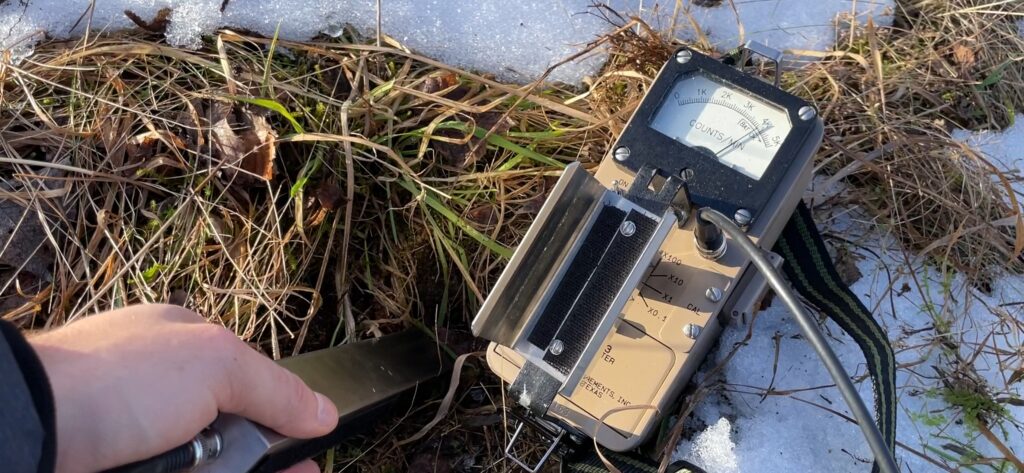
Since lead 210 is the only Radon daughter isotope with long half-life, it can accumulate and build up over time in areas where high levels of radon gas are present. This is the case with my DP-63-A, which insides are still heavily contaminated with Pb-210 despite the Radium dial being removed long time ago.

My sample
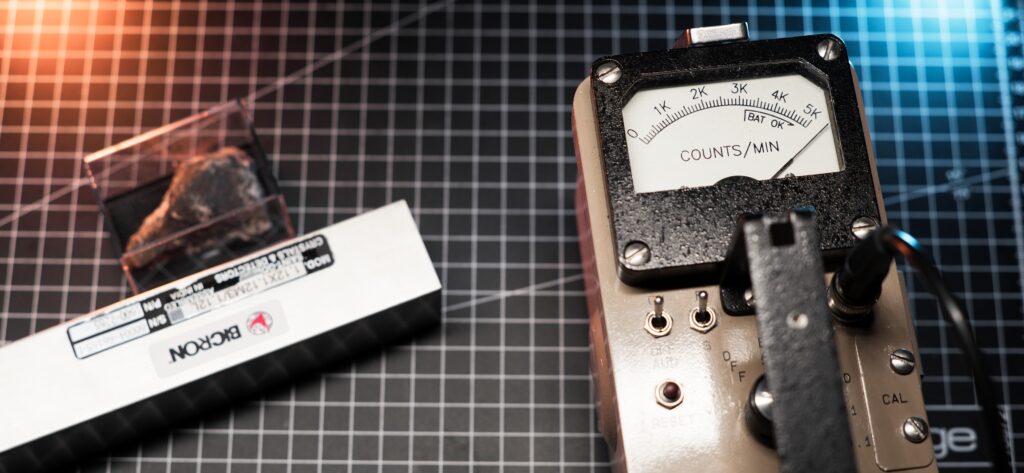
My sample of Lead 210 is a bit of an unconventional one. In order to create it, I used active carbon pallets which I then exposed to a strong radon emitter and I left them sealed in a jar for over two years. After removing the radon source, the jar was highly radioactive due to all the short lived isotopes being present but after a few day, they have decayed leaving only longer lived isotopes including Lead 210 and Polonium 210 inside.
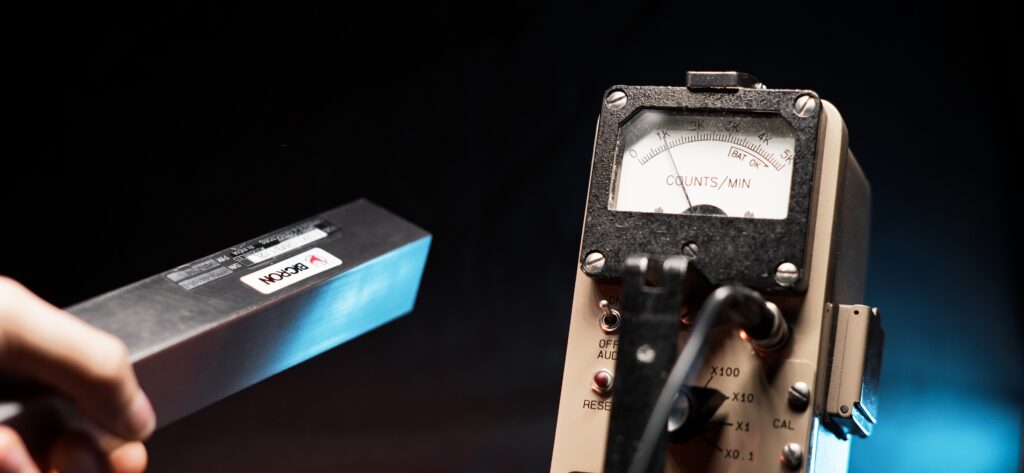
When the lid of the jar is removed, the active carbon pellets reads 500 CPM on my Ludlum Model 3 with a 44-9 probe when measured just above the opened jar. The gamma dose rate is just barely above background and my RAYSID only detects an increase of about 10 CPS when placed right next to the jar.

Gamma spectroscopy
A gamma spectroscopy of my Lead 210 revealed a clear peak at 47keV with a smaller X-ray peak to the left. This peak at 47keV can be also seen in gamma spectra of Uranium or Radium samples which makes it pretty interesting to see how peaks from parent isotopes star to disappear as we go lower in the decay chain.

Gamma spectra made with RAYSID <7% FWHM
Summary
Exploring the radioactivity of Lead 210 was a lot of fun and I certainly learned a lot about it! It definitely showed me that while radon might have a short half-life of only 3.6 days, its daughters will remain radioactive for many years to come.
If you want to find out more about Radon I recommend checking out my previous video on it, which I have linked in the description.
I want ot hear from you! Do you have any Lead 210 samples and what other radioactive isotopes should I cover in the future videos? Let me know in the comments below!
Thank you so much for reading this post, I hope you enjoyed it and learned something new! If yes, please make sure to subscribe to the email list so that you get notified when new posts are added. Also feel free to check out my Ko-Fi page where you can donate a nice cup of radioactive coffee and support my work financially.
and remember, stay active!