Trinitite – A piece of nuclear history

History

On July 16th, 1945 the United States tested its first nuclear weapon at the Trinity test site located in the Nevada desert, New Mexico. The bomb tested there was called the Gadget and it was a prototype of a Plutonium implosion-type bomb, similar to the one which was dropped on Nagasaki (Fat-Man).

Trinity test

When the Gadget exploded, the intense heat caused the steel tower, as well as surrounding sand to melt and form what we now call Trinitite.

Today, it is illegal to take Trinitite from the test site but you can buy it from different sellers online, who have collected it before the ban.

Different types of Trinitite

Trinitite comes in three different colours. The most common is green, a little bit rarer is red which contains copper from the wiring inside of the Gadget and finally black, which is the rarest and it contains iron from the steel tower on which the Gadget was placed.

Trinitite has a very low activity. When put together, my samples measured at around 110 cpm with a Pancake probe.

Trinitite sample under a microscope. You can see little bobbles containing air from 1945!

Fake trinitite & gamma spectroscopy of a real sample

Unfortunately, the rise in demand for Trinitite caused some scammers to start selling fake samples. They make them by mixing sand with radioactive isotopes such as 90Sr and then heating it to extreme temperatures. As a result, they create glass that is very similar in looks to Trinitite and even is slighly radioactive. In order to verify if the sample is real or not, it is best to do gamma spectroscopy of it. A spectrum of a real Trinitite should show the following isotopes 241Am (59 keV),133Ba (81 keV), 152Eu (123 keV, 245 keV, 344 keV), 137Cs (31 keV, 662 keV) and 60Co (1173 keV, 1332 keV).
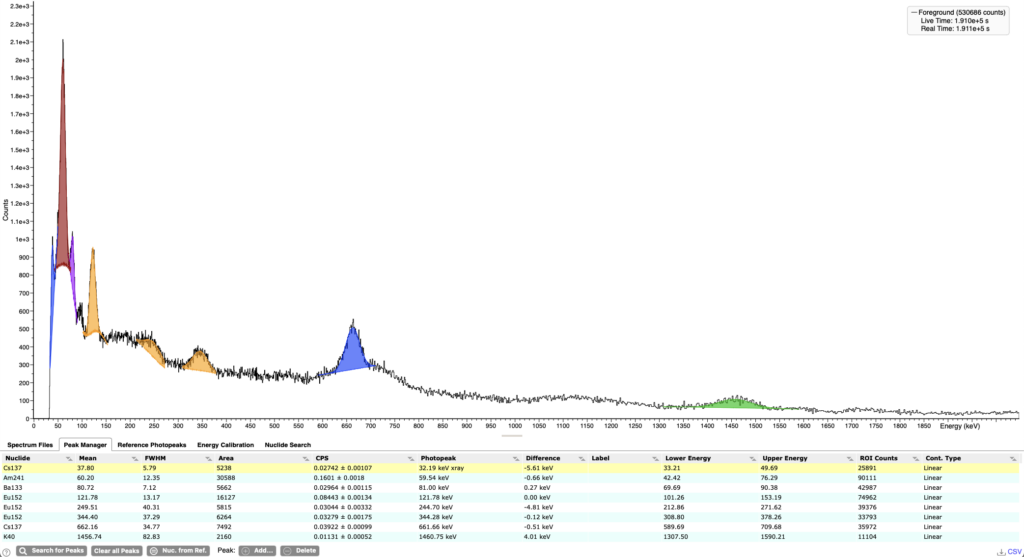
Gamma spectroscopy using RAYSID gamma spectrometer with a 5cm3 CsI(Tl) crystal

Radioactive Lutetium (176 & 177)

Uranium and Thorium along with Potassium are the most common, naturally occurring radioactive isotopes but there are also many other, lesser-known ones. One of them is Lutetium, which will be today’s main topic.

Lutetium is the last element in the Lanthanide series and it has been discovered in 1907 by French scientist Georges Urbain. Today Lutetium has very little commercial use due to its difficult production and high price but one of the uses is in the production of scintillation crystals which are used in positron emission tomography.

LYSO crystal

In nature, there are two isotopes of lutetium, 175Lu and 176Lu. Lutetium 176 is radioactive and it decays by a Beta emission into Hafnium 176 with a half-life of 37.8 billion (3.78×10¹⁰) years. Since Lutetium has a very long half-life, it is used in Lutetium-Hafnium dating of meteorites.

Lutetium has small, but detectible activity. My sample, which an LYSO crystal, measures 16 CPS above background on my RAYSID which has a [5cm3 (CsI(Tl) crystal]. Such activity is more than enough for gamma spectroscopy but it is not for measuring with a Geiger counter.

Lutetium has a very interesting gamma spectrum, it emits two gamma rays (202 keV and 307 keV) but since they are emitted at the exact same time, they sum up and form a peak at 509 keV.

176Lu gamma spectrum

Another use of lutecium is in the treatment of prostate cancer where a synthetic isotope of lutetium, 177Lu, is injected into patient’s body where it irradiates and kills cancer cells. Lutetium 177 emits two gamma rays at 113 keV and 208 keV.

177Lu gamma spectrum